Golden set · editor-reviewed
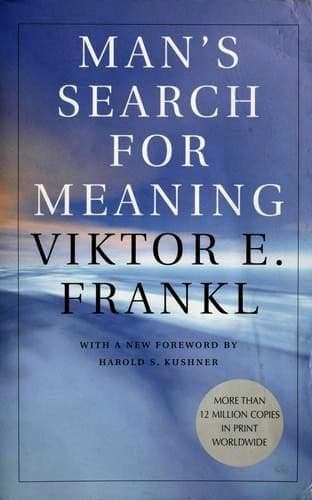
Man's Search for Meaning
Viktor Frankl·1946·Beacon Press·Psychology
Reading level: Ages 14+ (YA) · 4-hour read · Intermediate difficulty.
- Reading time
- 4h
- Difficulty
- Intermediate
- Recommended age
- Ages 14+ (YA)
- Guide read
- 6min
- Editor's rating
- 4.8 / 5
- holocaust
- psychology
- logotherapy
- memoir
- viktor-frankl
- meaning
— In one sentence —
A concentration-camp memoir and a clinical psychology in one short book. The memoir is unforgettable. The psychology has been thinned by misuse — read it back into context.
§ 01 · WHY READ
Why read
Viktor Frankl wrote Man's Search for Meaning in nine days in 1945, in Vienna, in the months after his release from Türkheim, a subcamp of Dachau. He had been imprisoned for nearly three years, across four camps — Theresienstadt, Auschwitz, Kaufering III, and Türkheim. His wife Tilly, his mother, his father, and his brother had been murdered. He was thirty-nine and had survived with, among other things, a manuscript he had been writing before the war hidden in his head.
The book has two parts, and they do different things.
Part One — "Experiences in a Concentration Camp" — is a hundred pages of memoir, written from inside the experience and from the clinical remove of a working psychiatrist. Frankl describes what happened to him and to the prisoners around him: the selection process at Auschwitz, the work details, the food, the cold, the small private acts of cruelty and kindness, the moment some prisoners gave up and the moment others did not, the day of liberation. The memoir is short, controlled, and refuses both sentimentality and false consolation. It is among the essential first-person accounts of the camps.
Part Two — "Logotherapy in a Nutshell" — is Frankl's theoretical framework: a school of clinical psychology he founded that posits the search for meaning as the primary human motivation (in contrast to Freud's pleasure principle and Adler's striving for power). This part is more abstract, more European-academic in register, and around forty pages.
The book's enormous late-career fame — over sixteen million copies sold — has been mostly the success of Part One, sometimes at the expense of Part Two, and frequently at the expense of both. There is no point being delicate: Man's Search for Meaning has been more widely quoted out of context than almost any modern book. Frankl himself was uncomfortable with the inspirational-poster version of his work. Reading the book whole, in order, is the corrective.
One specific clarification, since it comes up constantly: the line "Between stimulus and response there is a space. In that space is our power to choose our response. In our response lies our growth and our freedom" is frequently attributed to Frankl, including on coffee mugs and in management books. It is not in this book and is not, on careful checking, anywhere in Frankl's writings. The attribution appears to have spread via Stephen Covey's 7 Habits of Highly Effective People, where Covey credits the idea to something he read attributed to Frankl. The misattribution is so common that any encounter with the quote should be treated with suspicion. The actual Frankl is sharper and more specific than the slogan version.
§ 02 · SUBJECT / CAST
Subject / cast
This is a memoir of a singular subject within a vast cast he treats with restraint.
Viktor E. Frankl — the subject. A Viennese psychiatrist and neurologist, already trained and practicing at the time of his deportation in 1942. The clinical training is part of what produces the book's distinctive voice — Frankl is observing himself and his fellow prisoners as a psychiatrist would, even while suffering with them. The remove is not coldness; it is the only intellectual equipment he has, and he uses it.
The other prisoners — described, mostly, in types rather than individuals: the foreman who beat him, the kapos, the prisoners who organized food trades, the prisoners who walked into the wire. Frankl mentions individual names only when the example requires it. This is partly Holocaust-memoir convention of the period and partly Frankl's clinical framing: he is interested in patterns of response to extreme circumstance.
Tilly — Frankl's first wife, murdered in Bergen-Belsen at twenty-five. She appears briefly but at a crucial moment: Frankl describes, on a forced march in the snow, an experience of imagined dialogue with her that becomes one of the book's central evidences for his argument about meaning. Tilly is the absent center of much of the memoir.
The camps as institutions — Auschwitz, Kaufering III, Türkheim. Frankl is careful not to generalize his experience to all of the camp system; he is describing what he saw. The administrative center of the killing, the gas chambers, is largely offstage in his account because he survived the selection on arrival and was sent to labor. The book is a labor-camp memoir more than an extermination-camp one, and this fact matters for understanding what it can and cannot tell you about the Shoah.
§ 03 · HIGHLIGHTS
Three highlights
No. 1 · "The last of the human freedoms." The passage in which Frankl makes his central observation about the camp: that even there — stripped of family, name, possessions, future — the prisoners retained one thing, which was their freedom to choose their attitude toward what was happening to them. He is not claiming this freedom is a substitute for the lost ones, or that those who used it survived more often than those who didn't (he is explicit that survival was largely chance). He is claiming that even in the camp the inner life remained a domain of choice, and that this domain was where meaning could be found. The passage is the seed of the entire logotherapy framework, and it has been quoted, posterized, and detached from the camp context so often that re-encountering it in place is a small act of restoration.
No. 2 · The conversation with Tilly on the forced march. Frankl describes, in the book's most personal passage, a forced march in deep snow during which he silently held an imagined conversation with his wife. He did not know whether she was alive (she was already dead, though he didn't learn this until after liberation). The experience leads him to a formulation he treats as evidential rather than sentimental: that love is "the ultimate and the highest goal" to which a human can aspire, and that this is true whether or not the beloved is present, even whether or not the beloved is alive. The passage is the emotional core of Part One and the bridge into Part Two's theoretical argument.
No. 3 · The meaning-versus-happiness distinction. In Part Two, Frankl makes the distinction that has done more lasting work than almost anything else in the book: happiness, he argues, is not something you can pursue; it is something that ensues from pursuing meaning. He cites Nietzsche's "He who has a why to live for can bear almost any how" — repeatedly, throughout the book, as a kind of refrain. The argument is not that suffering is good (Frankl is explicit that one should not seek out suffering), but that unavoidable suffering becomes bearable, and even meaningful, when integrated into a why. This distinction is now ambient in contemporary self-help in greatly weakened form. Frankl's original version is stronger because it is rooted in the camp memoir of Part One.
§ 04 · EDITIONS
Recommended editions
| Edition | Why pick it |
|---|---|
| Beacon Press (2006 edition with foreword by Harold Kushner) | The most widely available US edition. Translation by Ilse Lasch; complete text of both parts plus Frankl's 1984 postscript "The Case for a Tragic Optimism." This is the version to start with. |
| Rider (UK / Penguin Random House UK) | The British edition, same translation. |
| Hodder & Stoughton (2004, with afterword by William J. Winslade) | Useful additional contextual material. |
| Audiobook (Simon Vance, Blackstone Audio) | Around four hours; Vance's reading is steady and unobtrusive. The book is short enough that audio is a viable first encounter. |
Avoid: heavily-abridged or "inspirational quote" editions. The full book is short. There is no reason to read a shortened version.
§ 05 · FIT
Who it's for / not for
Read this if you are…
- A reader who has encountered Frankl only in quotation and wants to know what the actual book says.
- Anyone interested in Holocaust memoir as primary historical and moral testimony.
- Readers interested in mid-century European psychiatry and its non-Freudian schools.
- Anyone who is doing the work of integrating loss, illness, or unavoidable suffering into a life they still want to live.
Skip it if you are…
- Currently in acute crisis around the Holocaust as a topic. The book is restrained but not gentle; if you are not ready for camp testimony, choose your moment.
- Looking for a self-help book with action items. Frankl is not Stephen Covey; the book provides a framework, not a program.
- Expecting a comprehensive history of the Shoah. Frankl is one survivor describing what he saw; for the institutional history, read Raul Hilberg, Saul Friedländer, or Timothy Snyder.
§ 06 · TIPS
Reading tips
- Read Part One before Part Two. This is how the book is structured and how it argues. Part Two's claims about meaning are only fully legible against the camp testimony.
- Resist the temptation to quote-mine. The book is short, and its sentences gain force from their place in the surrounding text. Quoting Frankl out of context is the default disrespect; read whole paragraphs.
- Hold the limitations in mind. Frankl is one survivor. His framework of "those who found meaning survived" should be read carefully — he himself qualifies it. Survival in the camps was overwhelmingly a matter of chance and circumstance. Frankl is describing inner experience, not predicting outcomes.
- Read the 1984 postscript ("The Case for a Tragic Optimism"). It contains Frankl's response to his book's reception and his refinements after four decades of clinical work. It is part of the book.
§ 07 · COMPARE
Read alongside
- Primo Levi — If This Is a Man / Survival in Auschwitz (1947). The other essential first-person camp memoir of the immediate postwar period. Levi is a chemist; Frankl is a psychiatrist; both are observing themselves and each other under conditions designed to destroy observation. Read together, they map the genre.
- Elie Wiesel — Night (1956). A younger man's account, more raw, less analytic. Useful as contrast in register.
- Etty Hillesum — An Interrupted Life (1981). Diaries of a young Dutch Jewish woman murdered at Auschwitz; in some ways the most direct interlocutor for Frankl's argument about meaning in extremis.
- Bessel van der Kolk — The Body Keeps the Score (2014). Contemporary trauma research, useful for situating Frankl's claims about psychological response to extreme circumstance in current clinical understanding.
- Hannah Arendt — Eichmann in Jerusalem (1963). The administrative side of what Frankl was inside. Arendt and Frankl knew of each other and disagreed; reading both is part of a serious encounter with the period.
§ 08 · DISCUSSION
Discussion questions
- Frankl draws a distinction between the search for meaning, the search for happiness, and the search for pleasure. How does the distinction work in his argument? Does it hold up against your own experience?
- "Between stimulus and response..." — the famous quote is not actually in this book. Why do you think it has been so persistently attributed to Frankl? What does the misattribution tell us about how the book has been received?
- Frankl writes that those who found a "why" were more likely to survive. He also writes that survival was largely chance. How do these two claims sit with each other? Is the book's argument weaker, stronger, or unchanged by holding both?
- Part One is memoir; Part Two is theoretical psychology. Do the two parts support each other? Or does one carry the book?
- Frankl's clinical training shaped his account of the camps. What does the psychiatric framing make visible? What might it hide?
- The Nietzsche line — "he who has a why to live for can bear almost any how" — is the book's refrain. Is this a description, a prescription, or both?
- The book has sold over sixteen million copies, often shelved as self-help. What is lost when Man's Search for Meaning is read as self-help? What, if anything, is gained?
- Frankl returned to Vienna after the war and lived another fifty-two years. The book contains almost no anger. Is the absence of anger a moral position, a temperamental fact, or a clinical strategy?
One line to remember
“He who has a why to live for can bear almost any how.”— Part One, quoting Nietzsche
Appears in collections
Reading lists featuring this book
You might also like
Read next
Dan Ariely · 2008
Predictably Irrational
Dan Ariely's behavioral-economics bestseller, and the nonfiction source behind NBC and Peacock's The Irrational.
Read · 6 min
Jonathan Wilson · 2008
Inverting the Pyramid
The classic modern tactics history for readers who want to understand what is happening on the pitch.
Read · 5 min
David Goldblatt · 2006
The Ball Is Round
A huge global history of football: empire, class, clubs, migration, money, nationalism, and the World Cup.
Read · 5 min