Golden set · editor-reviewed
Educated
Tara Westover·2018·Random House·memoir
Reading level: Ages 16+ (adult) · 11-hour read · Intermediate difficulty.
- Reading time
- 11h
- Difficulty
- Intermediate
- Recommended age
- Ages 16+
- Guide read
- 7min
- Editor's rating
- 4.6 / 5
- memoir
- education
- family
- fundamentalism
- memory
- estrangement
- westover
— In one sentence —
A memoir of building an education from nothing, by a writer who knows precisely how unreliable memory is — and refuses to pretend otherwise.
§ 01 · WHY READ
Why read
Educated is the rare bestselling memoir that is also a serious book. It has sold more than twelve million copies, sat on the New York Times nonfiction list for over three years, and was named one of the ten best books of 2018 by the Times. None of that is the reason to read it. The reason to read it is that Westover has written one of the most precise accounts in contemporary English of what it costs to construct a self out of a life that was supposed to make selfhood impossible.
The outline is by now well-known. Tara Westover was born in 1986 to a survivalist Mormon family in southeastern Idaho. Her father, who almost certainly suffered from undiagnosed bipolar disorder, believed the federal government was the agent of the Antichrist; her family stockpiled food, fuel, and weapons in preparation for the End of Days. None of the children had birth certificates until late; none attended school. Tara's "education" until age seventeen consisted of helping her father in his scrap yard, working alongside her mother (a self-taught midwife and herbalist), and reading whatever she could find. Her older brother Shawn, the most charismatic and most violent member of the family, escalated through her adolescence from emotional torment to physical assault.
At seventeen, Westover taught herself enough algebra to pass the ACT, enrolled at Brigham Young University, and from there moved to Cambridge as a Gates Scholar and then to Harvard as a visiting fellow. She finished a doctorate in intellectual history at Trinity College, Cambridge. By any conventional measure, this is a story about education as escape. Westover is not telling that story. She is telling the more difficult one underneath it: that the escape was also the loss of every person who made her, that an education is a thing you build by destroying the previous version of yourself, and that the family you grew up in does not stop being the family you grew up in just because you can now read Hume.
Most memoir of trauma settles into either confession or vindication. Educated refuses both. What it does instead — and what makes it a literary achievement rather than just a sociological one — is take seriously the unreliability of its own narrator's memory. Westover footnotes contested incidents. She quotes the divergent accounts of the same events given by different siblings. She marks the moments where her certainty about what happened has shifted over time. The book is structurally about the construction of a self that can hold contradictions without collapsing, and the prose enacts that construction line by line. It is one of the best-written nonfiction books of the last decade, and it is one of the most morally serious.
§ 02 · CHARACTERS
Characters
The cast is small — a family, a handful of professors, the brothers and sisters who do and don't escape.
Tara Westover — the narrator. Born in 1986, the youngest of seven, the one who left. The voice on the page is one of the memoir's most disciplined achievements: Westover never reaches for sympathy, never moralizes, and never pretends to certainty she does not have. When she does not remember something clearly, she says so. When her account contradicts a sibling's account, she presents both. The prose is plain, exact, occasionally beautiful, and always under the writer's control.
Gene Westover (a pseudonym) — Tara's father. A junkyard operator, fundamentalist Mormon, and almost certainly bipolar. Gene's certainty about the world is the structuring fact of his children's childhoods: a certainty about the government, about the medical system, about women's roles, about the imminent return of Christ. Westover writes him without caricature. He is loved, feared, dangerous, and — in the memoir's most unsettling passages — also, in his own terms, sincere.
Faye Westover — Tara's mother. A self-taught herbalist who develops a successful essential-oils business over the course of the memoir. Faye is the character whose moral evolution is the most painful to track: she is, at moments, the one who might intervene; she is, at moments, the one who chooses not to. Her trajectory across the book is the quiet engine of its argument about what loyalty means inside a family system that requires loyalty to the people doing the harm.
Shawn Westover (a pseudonym) — Tara's older brother. The memoir's most frightening figure: charismatic, capable of real tenderness, and capable of escalating violence toward Tara that the family will, for years, refuse to recognize as violence. The chapters in which Westover narrates Shawn's abuse are written with a deliberate flatness that makes them harder to read, not easier.
Tyler and Richard — the two older brothers who also leave for college. They are the memoir's evidence that escape was possible, and the evidence that the cost of escape is not the same for everyone.
The professors at BYU and Cambridge — Kerry, Steinberg, Runciman. The figures who, in small ways, recognize what they are looking at and offer Westover the tools she needs. The Steinberg seminar scene at Cambridge is one of the memoir's quiet pivots.
§ 03 · HIGHLIGHTS
Three highlights
No. 1 · The footnotes and the methodology of memory. The most-overlooked formal feature of the book is its scrupulous handling of contested memory. Westover footnotes events where her family members remember things differently than she does, and the footnotes are not defensive — they are interested in the question. A memoir whose narrator marks the limits of her own reliability is doing something rare in the genre, and Westover does it without making the marking feel like a hedge. The methodology is the moral position: she is not asking you to believe her because she is sure; she is asking you to consider what she remembers, alongside what others remember, and decide how to read.
No. 2 · The slow construction of an education. The chapters covering BYU, Cambridge, and Harvard are not triumphalist. They are the harder kind of academic chapter: the slow, embarrassed accumulation of basic knowledge that other students have had for years, the moments of looking up a word in class that everyone else seems to know, the gradual recognition that the texture of the world she grew up in is not the texture of the world. The single most-quoted moment is when Westover, in a Holocaust history class, raises her hand to ask what the Holocaust was. It is also where the book is doing its most precise work about the difference between ignorance and stupidity — a difference the academic world is not always good at registering, and which Westover's professors, to their credit, mostly do.
No. 3 · The family rupture. The final third of the memoir is about Westover's increasing recognition that the family she came from is going to require her to choose between her safety and their version of events. The rupture, when it comes, is not dramatic. It is a series of small choices, each of which seems survivable until they aren't. The chapters covering Westover's psychological collapse after the rupture — her doctoral work nearly ending, her sense of self nearly ending — are some of the most honest accounts in contemporary memoir of what it costs to leave a family that requires lying to remain in. The book does not pretend this was a victory. It is a survival.
§ 04 · EDITIONS
Recommended editions
| Edition | Why pick it |
|---|---|
| Random House hardcover (US, 2018) | The first edition. Standard hardcover; the one most readers encountered. |
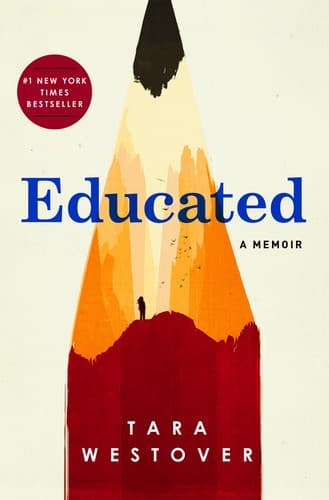
| Hutchinson (UK, 2018) | The British first edition. Same text; the UK cover is the harder-to-find one with the silhouette and pencil. |
| Random House paperback (2019) | Includes a brief author Q&A and a reading-group guide. Useful for book clubs; the Q&A is not spoilery. |
| Audiobook (Julia Whelan, Random House Audio, 2018) | One of the great audiobook performances of the decade. Whelan finds the exact register Westover's prose requires — flat where it needs to be flat, alive where it needs to be alive, never over-acted. If you read this book in print, listen to it on the second pass. |
There is no film adaptation as of 2026, and the book's interiority — the slow construction of a thinking self — would be difficult to put on screen. Be cautious of the secondhand summaries circulating online; many of them flatten the book's careful epistemology into a simpler narrative of escape.
§ 05 · FIT
Who it's for and who it's not for
Read this if you are…
- Interested in memoir as a literary form and want to read one of the best contemporary practitioners.
- Drawn to the question of what an education actually is and what it costs to acquire one.
- Thinking about your own family, your own estrangements, the people you have had to leave to become someone they would not have wanted you to be.
- Curious about the inside texture of American religious fundamentalism, told without sneering and without exculpation.
Skip it if you are…
- Looking for a redemption arc with a clear villain and a clean ending. The villain is loved. The ending is unresolved.
- Sensitive to extended depictions of physical abuse, psychological abuse, and serious untreated mental illness. The Shawn chapters are difficult.
- Currently in a fragile place with your own family of origin. The book is honest in ways that may not be useful to read while you are making decisions of your own.
- Allergic to memoir as a genre on principle. Educated is a stronger argument for the form than most, but it is still memoir, and if you cannot tolerate the form, this will not convert you.
§ 06 · TIPS
Reading tips
- Read the footnotes. They are short, they are part of the book's argument, and they will reshape how you read certain passages.
- Slow down for the abuse chapters. Westover's deliberate flatness in these passages can lull you into reading too fast. They reward — and require — careful attention.
- Notice the prose register changes. The childhood chapters are written in one voice; the university chapters in a slightly different one; the late chapters in a third. The register is doing structural work.
- Don't read this as a how-to. It is not a guide to escaping a difficult family, and the book actively resists being read that way. The cost Westover pays is not generalizable.
- After finishing, read it again — at least the first chapter and the last. The first chapter reads completely differently after you have read the last.
§ 07 · COMPARE
Read alongside
- Jeannette Walls — The Glass Castle (2005). The other great American memoir of a difficult childhood in the rural West. Walls is warmer; Westover is more philosophically rigorous. Read both.
- Mary Karr — The Liars' Club (1995). The book that made the modern American memoir possible. Karr is the prose ancestor.
- Joan Didion — The Year of Magical Thinking (2005). A different register of grief and memory, but the same attention to the unreliability of one's own account of one's own life.
- Hillbilly Elegy — J. D. Vance (2016). The other memoir about leaving the rural American working class for the meritocratic Ivy League world. Politically a very different book; useful to read alongside Educated as a contrast in tone, argument, and authorial honesty.
- Lucia Berlin — A Manual for Cleaning Women (2015, posthumous). Fiction, not memoir, but the same close attention to the texture of difficult lives, written by someone who lived them.
§ 08 · DISCUSSION
Discussion questions
- Westover footnotes contested memories throughout the book. Pick one footnote. What does it do to your reading of the passage it annotates? What does it do to your sense of the narrator?
- The book is titled Educated, not Escape or Survival. What does the title commit Westover to as a writer? What does it commit you to as a reader?
- The Steinberg seminar scene at Cambridge — when a professor recognizes Westover's writing — is a quiet pivot. Why does Westover place it where she does? What would be different if it came earlier or later?
- Faye, Westover's mother, has the memoir's most morally complicated arc. State the case for and against her. Which is harder to make?
- Shawn's violence is depicted with a deliberate flatness. What does the flatness do that more dramatic prose would not?
- The final chapters are about Westover's psychological collapse after the family rupture. Why does she put this after, not before, the academic triumphs? What is the structural argument?
- The book is sometimes read as a triumphalist escape narrative. Where in the text does Westover actively resist that reading? Where, if anywhere, does she permit it?
- What is owed to family members who harmed you? The book refuses a clean answer. Construct your own from the text and defend it with specific passages.
One line to remember
“You can love someone and still choose to say goodbye to them. You can miss a person every day, and still be glad that they are no longer in your life.”— Tara Westover — Chapter 40, near the memoir's end
You might also like
Read next
Trevor Noah · 2016
Born a Crime: Stories from a South African Childhood
A comedian's memoir that turns out to be a book about his mother. The funny parts are funny; the parts that aren't will catch you off guard.
Read · 6 min
Belle Burden · 2026
Strangers: A Memoir of Marriage
A 2026 memoir about marriage, rupture, and the shock of realizing intimacy does not guarantee knowledge.
Read · 5 min
James Herriot · 1972
All Creatures Great and Small
James Herriot's first Yorkshire veterinary memoir, and the source doorway for the PBS Masterpiece series.
Read · 6 min