Editor-reviewed
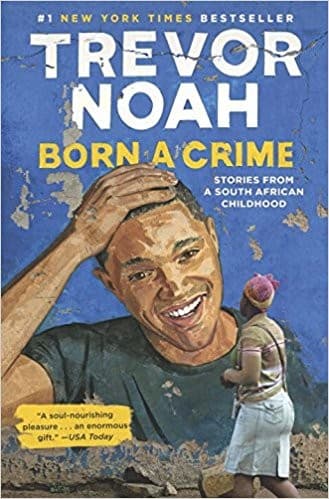
Born a Crime: Stories from a South African Childhood
Trevor Noah·2016·Spiegel & Grau·memoir
Reading level: Ages 13+ (YA) · 9-hour read · Beginner difficulty.
- Reading time
- 9h
- Difficulty
- Beginner
- Recommended age
- Ages 13+ (YA)
- Guide read
- 6min
- Editor's rating
- 4.4 / 5
- memoir
- south-africa
- apartheid
- trevor-noah
- comedy
- motherhood
— In one sentence —
A comedian's memoir that turns out to be a book about his mother. The funny parts are funny; the parts that aren't will catch you off guard.
§ 01 · WHY READ
Why read
Trevor Noah was born in Johannesburg in 1984, to a Xhosa mother and a Swiss-German father, at a time when sexual contact between a black woman and a white man was a criminal offense under apartheid's Immorality Act. His existence was, in the most literal sense the legal system could supply, evidence of a crime — his mother's crime, since under the law she would have served the longer sentence. The title of the memoir is not a metaphor.
This is the premise. The book is mostly not about it.
What Born a Crime is actually about is Patricia Nombuyiselo Noah — Trevor's mother, the book's true subject, a Xhosa woman who learned to read in secret as a child, escaped a domestic-service track to become a secretary in a Johannesburg white firm, decided independently that she wanted a child and chose a Swiss neighbor to father one, raised that child as a single mother through the end of apartheid and the years after, survived an abusive second marriage and a literal gunshot to the head, and remains, in Noah's account, the most formidable person he has ever met. The memoir is, among other things, a love letter to her.
The other thing the book does well, and that distinguishes it from celebrity memoirs more generally, is that Noah refuses to use comedy as a shield. The funny chapters — and many are very funny — sit beside chapters about apartheid's specific cruelties, his stepfather's escalating violence, the racial logic that made him "colored" by South African classification and therefore neither black nor white nor easily anything else. The comedy doesn't cover the violence; it sits next to it.
It became one of the best-selling memoirs of the late 2010s, and the audiobook, in particular, became a phenomenon for reasons we explain below.
§ 02 · SUBJECT / CAST
Subject / cast
The book is a memoir, but it functions as a dual portrait — of Noah and of his mother.
Patricia Nombuyiselo Noah — the book's true subject. A Xhosa woman who refused, in nearly every season of her life, to do what the people around her thought she should. Deeply religious (the family attends three churches each Sunday), formidably stubborn, capable of switching languages mid-sentence to gain leverage in any room. Patricia is the source of the book's moral seriousness and most of its best lines. The relationship between her and Trevor — affectionate, combative, mutually frustrating, unbreakable — is the through-line.
Trevor Noah — the narrator, writing in his early thirties (he was the host of The Daily Show when the book was published in 2016). The voice is comedian-stand-up — anecdote-driven, set-up-and-punchline-shaped — but the structure is more careful than the prose lets on. Each chapter has an essay-shaped frame in italics that situates the personal story in apartheid's legal or social architecture; the chapter itself then tells the story.
Abel — Trevor's stepfather, Patricia's second husband. The book's antagonist, in the limited sense that a memoir has antagonists. An alcoholic mechanic whose violence escalates across years and culminates in the event Noah describes in the final chapter. Noah is careful with him: not exculpating, but not flattening him into a villain either.
The neighborhoods — Soweto (his grandmother's home), Eden Park (the mixed-race area where Patricia moved), Highlands North (the white suburb she eventually bought into). Noah moves between them in ways the apartheid system was designed to prevent, and the book uses these moves to map the system's grain.
§ 03 · HIGHLIGHTS
Three highlights
No. 1 · Trevor, jumping out of a moving minibus. The book's opening anecdote: nine-year-old Trevor and his mother, on a Sunday morning, find themselves trapped in a minibus taxi whose driver has become threatening because Patricia is a Xhosa woman traveling with what he reads as a "colored" child and what he believes is a white man (Patricia's eventual stepfather problem, in miniature). Patricia, mid-ride, opens the moving van's door and pushes Trevor out, then jumps after him. The chapter is funny and also a working demonstration of what it took to survive South Africa as the wrong combination of people. The book begins as it intends to continue: the comedy is the surface, the danger is the substance.
No. 2 · The chocolate factory and the chameleon strategy. Noah explains how he learned, as a child, that switching languages was a form of survival — speak Zulu to a Zulu shopkeeper, Xhosa to a Xhosa one, Afrikaans to a white one, English when neutrality served. He could pass between groups because none of them quite claimed him. The chapter on language is the book's most analytic section, and it's where the memoir does its sharpest thinking about how apartheid's racial categories operated and how someone outside the categories could move through them.
No. 3 · The shooting. The final chapter — without spoiling its full structure — describes the event in which Patricia is shot in the head by Abel. She survives. The chapter is written with the comedian's instinct for timing turned in a different direction; the laughs in earlier chapters set up the seriousness here. Patricia's response in the hospital, which Noah reports verbatim, is the book's last and best joke and also the line that justifies the entire memoir's tone. We will not quote it here. Read it in context.
§ 04 · EDITIONS
Recommended editions
| Edition | Why pick it |
|---|---|
| Spiegel & Grau hardcover (2016) | The first edition; standard text. |
| One World paperback (2019) | The current in-print US edition after the Spiegel & Grau imprint closed. Identical text. |
| Audiobook (read by Trevor Noah) | The audiobook is widely regarded as superior to the print edition — possibly the strongest case for audio over print in contemporary memoir. Noah reads it himself and performs the dialogue in the original languages: his mother in Xhosa and English, his grandmother in Zulu, his stepfather in a specific register, the white shopkeepers in Afrikaans, the township in tsotsitaal. The book is about language and code-switching; the audiobook enacts what the print can only describe. If you read one version, read this one. |
| Young Readers Edition (Delacorte, 2019) | An adapted edition for readers around middle-school age. Some material is omitted or softened. The adult version is suitable for most teen readers; the YR is for younger ones. |
§ 05 · FIT
Who it's for / not for
Read this if you are…
- A reader who wants a memoir that takes its political setting seriously without becoming a history lecture. Noah uses his own life to teach apartheid's structure in a way no textbook will.
- An audiobook listener. (Seriously: this is the rare book where the format choice matters.)
- A reader interested in mother-son relationships rendered without sentimentality.
- Anyone who has read or watched Noah's comedy and wants to understand where the voice came from.
Skip it if you are…
- Looking for a comprehensive history of apartheid. Noah is selective and personal; for the full historical picture, read elsewhere (e.g., Sampie Terreblanche's A History of Inequality in South Africa or, for testimonial history, Country of My Skull by Antjie Krog).
- Uncomfortable with violence in a memoir. The domestic abuse and the shooting are not gratuitous, but they are not softened.
§ 06 · TIPS
Reading tips
- Listen, don't read, if you have the choice. This is unusual advice — we generally prefer print — but the audiobook is a different and better work.
- Read the italicized framing sections. Each chapter opens with a short essay that explains a piece of apartheid's legal or social architecture. These are easy to skim. Don't.
- The book is not chronological. Chapters are organized thematically; you'll loop back through childhood multiple times from different angles. This is intentional.
- Read the last three chapters in order. The book's structural argument depends on the sequence in which the final material is delivered.
§ 07 · COMPARE
Read alongside
- Trevor Noah — Patriot Act / Daily Show clips (online). Useful only if you've never seen Noah perform. Helps calibrate the voice on the page.
- Nelson Mandela — Long Walk to Freedom (1994). The autobiography Noah's mother's generation read. A different register entirely; useful as historical scaffolding.
- Antjie Krog — Country of My Skull (1998). A poet's account of the Truth and Reconciliation Commission. The grown-up companion to Noah's childhood-eye view.
- J.M. Coetzee — Disgrace (1999). The post-apartheid moment in fictional form. Coetzee's South Africa is a darker register; the two books together give a stereoscopic view.
- Ta-Nehisi Coates — Between the World and Me (2015). A different father-son frame (Coates to his son; Noah to and from his mother), but both books work as letters about race that refuse easy consolation.
§ 08 · DISCUSSION
Discussion questions
- The book is structured as a memoir of Trevor Noah but reads, by the end, as a portrait of Patricia. Is this the book Noah set out to write? What does it mean that his memoir is centrally about someone else?
- Noah uses comedy throughout, including in chapters about violence and grief. When does the humor work, and when (if ever) does it feel evasive?
- The italicized framing sections explain apartheid's legal architecture in a few paragraphs at the start of each chapter. Is this an effective way to teach the system? What does it ask of the reader?
- Language is one of the book's central themes. How does Noah's multilingualism shape his account of identity? What does it mean to be able to "pass" linguistically when you can't pass visually?
- Abel, the stepfather, is the book's antagonist but is not flattened into a villain. How does Noah portray him? Is the portrayal too generous, too harsh, or right?
- The audiobook is widely considered superior to the print edition. If you've experienced both, what does the audio do that the page can't?
- Patricia's religious faith is presented as both a source of strength and a source of constraint. Does the book settle which it is, or does it leave the question open?
- Noah was born under apartheid and grew up across its end. How does the book handle the transition? Is post-apartheid South Africa a less violent place for the family? In what ways yes and no?
One line to remember
“My mother used to tell me, 'I chose to have you because I wanted something to love and something that would love me unconditionally in return.'”— Chapter 4
You might also like
Read next
Tara Westover · 2018
Educated
A memoir of building an education from nothing, by a writer who knows precisely how unreliable memory is — and refuses to pretend otherwise.
Read · 7 min
Belle Burden · 2026
Strangers: A Memoir of Marriage
A 2026 memoir about marriage, rupture, and the shock of realizing intimacy does not guarantee knowledge.
Read · 5 min
James Herriot · 1972
All Creatures Great and Small
James Herriot's first Yorkshire veterinary memoir, and the source doorway for the PBS Masterpiece series.
Read · 6 min