Editor-reviewed
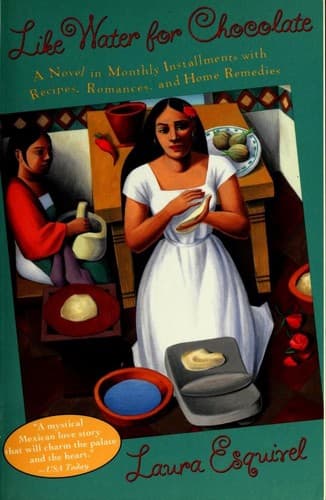
Like Water for Chocolate
Laura Esquivel·1989·Vintage·Literature
Reading level: Ages 16+ (adult) · 5-hour read · moderate difficulty.
- Reading time
- 5h
- Difficulty
- moderate
- Recommended age
- Ages 16+
- Guide read
- 6min
- Editor's rating
- 4.2 / 5
- laura-esquivel
- hbo-adaptation
- mexican-literature
- magical-realism
- romance
— In one sentence —
Laura Esquivel's Mexican love-and-food novel behind the HBO and film adaptations.
§ 01 · WHY READ
Why read
Like Water for Chocolate is Laura Esquivel's novel about Tita de la Garza, food, family duty, forbidden love, and magical realism during the Mexican Revolution. Warner Bros. Discovery's HBO materials identify the current series as based on Esquivel's novel, and Penguin Random House lists the Vintage English edition with ISBN 9780385420174.
The book's structure is simple and memorable: each chapter turns around a month, a recipe, and an emotional crisis. Food is not decoration. It is the way Tita is allowed to speak when her family rules deny her a direct life.
Read it if the HBO series or the earlier film made you want the source. The novel is short, sensory, and sharp about how domestic tradition can become a prison.
§ 02 · CHARACTERS
Characters
Tita de la Garza is the youngest daughter, expected to remain unmarried and care for her mother.
Pedro Muzquiz loves Tita but marries her sister so he can stay near her.
Mama Elena enforces the family rule that blocks Tita's adult life.
Rosaura becomes Pedro's wife and Tita's sister-rival inside the same house.
Nacha teaches Tita the kitchen language that becomes the novel's emotional system.
§ 03 · HIGHLIGHTS
Three highlights
No. 1 - Active HBO source route. WBD's current HBO materials name Esquivel's novel and keep the screen connection fresh.
No. 2 - Short classic shape. The book is accessible without being slight, which makes it useful for new adaptation readers.
No. 3 - International catalog value. It adds Mexican literature, romance, food writing, and magical realism to the screen shelf.
§ 04 · EDITIONS
Recommended editions
| Edition | Why pick it |
|---|---|
| Vintage paperback | Current English route with ISBN 9780385420174. |
| Vintage ebook | Practical if you want a quick read before watching. |
| Special bilingual edition | Useful for readers comparing Spanish and English paths. |
| Audiobook | Works well if you like a story organized around food and voice. |
§ 05 · FIT
Who it's for / not for
Read this if you are...
- Coming from HBO's Like Water for Chocolate or the 1992 film.
- Interested in magical realism grounded in family pressure.
- Looking for a short literary romance with food at its center.
- Curious about Mexican literature in translation.
Skip it if you are...
- Avoiding family control, grief, sexual longing, or pregnancy loss.
- Wanting a modern romance with equal freedom for both leads.
- Looking for a purely realistic domestic novel.
- Frustrated by heightened symbolism around food and emotion.
§ 06 · TIPS
Reading tips
- Read the recipes as structure. They organize time, memory, and feeling.
- Watch Mama Elena's rule. One family tradition changes every adult choice around it.
- Do not flatten the magic. The magical moments are how the book makes emotion physical.
- Compare adaptations by emphasis. Screen versions can show food beautifully, but the novel's monthly rhythm matters.
§ 07 · COMPARE
Read alongside
- Isabel Allende - The House of the Spirits. For another screen-linked Latin American novel with family history and magical elements.
- Gabriel Garcia Marquez - One Hundred Years of Solitude. For a larger magical-realist family saga.
- Jojo Moyes - Me Before You. For romance readers thinking about constraint and choice.
- Daphne du Maurier - Rebecca. For a different house where power and desire are hard to separate.
- Laura Esquivel - The Law of Love. External follow-up for readers who want more of Esquivel's blend of romance and invention.
§ 08 · DISCUSSION
Discussion questions
- How does food become Tita's language?
- Is Pedro's choice understandable, selfish, or both?
- What makes Mama Elena powerful inside the house?
- How does the novel connect recipe, body, and memory?
- What should HBO preserve from the book's monthly structure?
- Does magical realism make the family conflict clearer?
- How does the Mexican Revolution affect the domestic plot?
- Is the ending romantic, tragic, or something more complicated?
One line to remember
“Tita's life is measured in recipes, family rules, and a love she is forbidden to live openly.”— bibliotecas editorial summary, not a textual quotation
You might also like
Read next
William Faulkner · 1936
Absalom, Absalom!
Four narrators reconstruct a man who destroyed his family. The story keeps changing. That is the point.
Read · 7 min
Toni Morrison · 1987
Beloved
Toni Morrison said she wrote this novel to give voice to the sixty million. It won the Pulitzer, the Nobel, and is the greatest American novel of the second half of the twentieth century.
Read · 6 min
Giuseppe Tomasi di Lampedusa · 1958
The Leopard
The Sicilian classic behind Netflix's Italian limited series.
Read · 6 min