Book list · Editor's pick·Vol. 001·Sci-Fi & Fantasy
Liu Cixin's Three-Body Trilogy · A 3-Book Reader's Guide
Three novels, two translators, one universe that ends. Where you start depends on what you came for.
- Books
- 3
- Total reading
- 49h
- Authors
- 1
- Translators
- 2
- Time span
- 2008–2010 (Chinese) · 2014–2016 (English)
- chinese-sf
- hard-sf
- first-contact
- dark-forest-theory
- trilogy
- where-to-start
Updated 2026-05-20
— Why read this list —
Liu Cixin wrote the most ambitious SF trilogy of the 21st century. You can read it in three different orders. Two of them are wrong for most people.
Why these three
There is exactly one Chinese science-fiction trilogy that has crossed into English-language SF in a way the genre has had to take seriously. Whatever you think of Cixin Liu — and there are real things to think — the Remembrance of Earth's Past trilogy is the only post-2000 SF series in any language that has reshaped what English-language readers think hard SF is allowed to do.
We are not the first to recommend reading it. We are trying to be one of the few who tell you, before you start, what the three books actually are — so that the time and money you spend on a 49-hour reading commitment is spent for the reasons you want to spend it.
The trilogy as a whole is about whether the universe permits civilizations to continue, and what species do when they discover the answer is no. Book 1 stages the question inside the Cultural Revolution. Book 2 derives the universe's silence from two stated axioms. Book 3 walks the consequences out to the end of time. The argument compounds: skip a book and the next one stops working.
We are not pretending the books are flawless. Liu Cixin is open about not being able to write people — his interiority is functional, his dialogue is utilitarian, his pacing in the first hundred pages of every book is slow. Western reviewers who came for the prose found the prose wanting. They missed the trilogy's actual technique, which is to use thin character to load the reader with the premises the next two thousand pages will test. Once you understand that the people on the page are mostly there to make the universe-scale moves legible, you can stop wanting them to be Updike and start watching Liu do what he's actually doing.
We also are not pretending the trilogy has no problems. Book 2's central romance is a difficult read for many female readers; Book 3's protagonist is a flashpoint in twenty-first-century SF fandom for reasons that braid honest character-design issues with disproportionate gendered backlash. We address these in the individual book guides; here we just say: you can read this trilogy and disagree with it. We do, in places.
Three orders. Pick one before you start.
There is no single correct reading order. There are three defensible ones, and they suit different readers. If you don't know which one you are, take the first — it's the order Liu wrote them in, and the order most readers should follow.
(Each path uses the same three books. The order is what changes — and what you notice changes with it.)
How to use this guide
This collection works in two layers:
The first layer is below: an entry per book, in publication order, with our collection-internal pitch. Use it as the index. Click "Read the full guide" on any entry to get our 10-module deep dive on that book.
The second layer is the path you chose. Each path's flow tells you which book to start in; the entries below tell you what to know about each. Read the relevant entry's pitch before you crack the book, and the full guide if you want to be primed for what's load-bearing in that particular volume.
A few practical notes:
- Translation choice matters. Ken Liu translated Books 1 and 3; Joel Martinsen translated Book 2. Many readers feel Books 1 and 3 read slightly more fluidly. Both translations are good; both are the only ones we'd recommend. Avoid older pre-2014 fan translations.
- The trilogy was originally a single Chinese novel, then split into three for serialization. This is structurally relevant: Book 1's ending was rewritten for English release, and Books 2 and 3 are tighter on a reread than on first pass.
- Don't read fast. This is a trilogy that rewards patience and rereading; the canonical reader-experience is to slow down in the climactic chapters of each book and then immediately go back to find what was foreshadowed.
- Take a break between books. Each volume is structurally complete; bingeing the trilogy can blur what each book is individually doing.
The trilogy will take you between 35 and 60 hours, depending on reading speed and how many of our companion guides you read alongside it. Plan for two to three weeks at a leisurely pace, two weekends if you commit.
The three book entries follow.
Reading paths
Three orders. Pick one before you start.
If you're new to SF entirely
Read in publication order. The first book is your training in Liu Cixin's voice and the trilogy's frame; you need that before the bigger books work.
Book 1›Book 2›Book 3
If you've read Asimov, Clarke, Le Guin, Ted Chiang, Greg Egan
Read Book 2 first as a standalone, then come back to Book 1, then finish with Book 3. The Dark Forest is the trilogy's best argument; if it doesn't win you, the others won't either. Caveat: you'll miss some structural pleasure of Book 1 if you read it second.
Book 2›Book 1›Book 3
If you care about prose, character, and ambition more than concept
Read Book 1 to get the frame, skip ahead to Book 3 for the literary peak, end with Book 2 as a focused study of the central idea. You will be one of about three people in the world who has read the trilogy this way; the upside is that the most beautiful book lands in the middle.
Book 1›Book 3›Book 2
The 3 books
In publication order
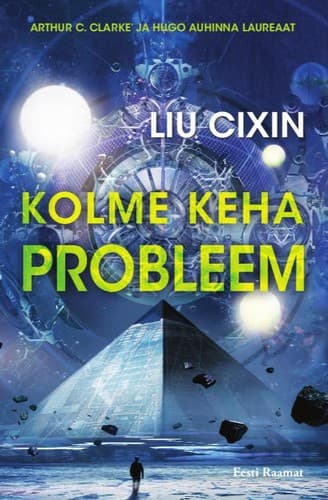
Book 1·The cause
The Three-Body Problem
Cixin Liu·2008·trans. Ken Liu (2014)
The foundation. A novel about whether a civilization should be allowed to choose its own end on humanity's behalf — set inside the Cultural Revolution. Most-praised opening chapter in modern SF. Slowest middle. Highest-stakes climax-by-implication of the three. If you skip this book you will not understand the next two.
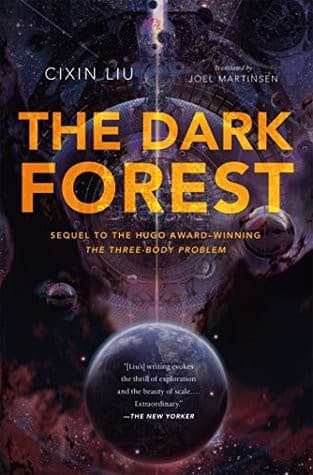
Book 2·The thesis
The Dark Forest
Cixin Liu·2008·trans. Joel Martinsen (2015)
The peak. Fan consensus + the author's own opinion: the best book in the trilogy. Two simple axioms derive the silence of the universe. Luo Ji's arc is the only complete character arc in the three books. The climax is a single sentence that stops a 200-year war. Read this slowly.
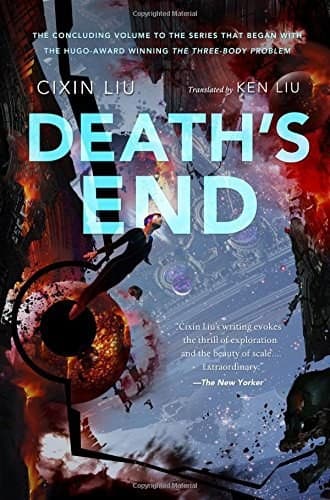
Book 3·The conclusion
Death's End
Cixin Liu·2010·trans. Ken Liu (2016)
The most ambitious. 22 billion years of cosmic history, two morally catastrophic decisions by one woman, one universe reset at the end. The most divisive book of the three — partly because the central character makes choices most readers find painful. The fairy tales of Yun Tianming and the dimensional-attack sequence are the trilogy's literary high points.