Editor-reviewed
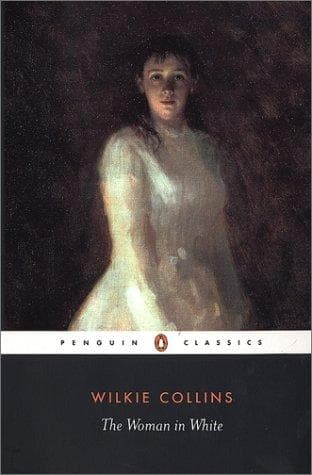
The Woman in White
Wilkie Collins·1859·Sampson Low·Literature
Reading level: Ages 14+ (adult) · 22-hour read · Intermediate difficulty.
- Reading time
- 22h
- Difficulty
- Intermediate
- Recommended age
- Ages 14+
- Guide read
- 6min
- Editor's rating
- 4.7 / 5
- wilkie-collins
- victorian
- thriller
- classic
- mystery
- detective
- sensation
- women
— In one sentence —
Collins invented the detective novel. This is where it started — and it's still one of the most gripping books in English.
§ 01 · WHY READ
Why read
Wilkie Collins published The Woman in White in serial form in 1859 and set off a cultural phenomenon. Readers of All the Year Round waited each week for the next installment; Collins received more fan mail than any English novelist before him; the novel sold out in three days when published in book form. This was not because it was sensational entertainment for the masses — though it is supremely entertaining — but because Collins had invented something new.
The novel is the origin point of the detective novel, the legal thriller, and the domestic suspense story simultaneously. Its techniques — multiple narrators each presenting their section of the case, withheld information deployed for maximum revelation, the patient accumulation of evidence, the intersection of legal machinery with personal catastrophe — are the direct ancestors of every procedural thriller, every courtroom drama, and every locked-room mystery published since.
But Collins was not only a genre pioneer. The novel is also a sustained argument about women and the law in Victorian England. Laura Fairlie, stripped of her identity, fortune, and legal existence by a forged death certificate, has no recourse under the law because the law does not recognize married women as persons separate from their husbands. Marion Halcombe, the novel's actual protagonist in everything but name, is brilliant, decisive, and legally powerless. Collins understood that the thriller's appeal — someone has committed a crime and must be caught — was most powerful when the victim could not, by law, be the agent of her own rescue.
Count Fosco remains one of the great villains of English literature: fat, charming, cultured, and utterly amoral. He is still being imitated.
§ 02 · CHARACTERS
Characters
Marian Halcombe — the novel's genuine hero, despite its nominally centering on the male narrator Walter Hartright. She is ugly by Victorian standards (dark, mannish), brilliant, loyal, and the only person in the novel equal to Fosco intellectually. Count Fosco is so impressed by her that he pays her a tribute in his own diary — the highest compliment the novel offers. She is limited only by the law and her body; she falls ill at the novel's crucial moment, and the investigation stalls until Walter takes it up. This is not a coincidence: it is Collins's argument about what Victorian women were permitted to accomplish.
Count Fosco — the Italian aristocrat, Sir Percival Glyde's co-conspirator, and one of English literature's great originals. He is enormous, soft-voiced, kind to small animals, devoted to his wife in a terrifying way, and genuinely dangerous. His intelligence makes him appealing; his amorality makes him frightening. Collins gives him the novel's best scenes: his tribute to Marian, his manipulation of the plan, and his final, self-serving but brilliantly written confession.
Laura Fairlie — the woman whose identity is stolen and who spends much of the novel legally dead. She is sweet, passive, and — in the context of the novel's argument — precisely the kind of woman the Victorian legal system could most easily destroy: a married woman without property, with no legal existence independent of her husband. Her victimhood is not a flaw in the characterization; it is the argument.
Walter Hartright — the drawing teacher turned investigator who narrates the novel's opening and closing sections. He is determined, methodical, and somewhat colorless compared to Marian and Fosco — which is Collins's point. The hero of the Victorian thriller is the accumulator of evidence, not the possessor of genius.
Sir Percival Glyde — the villain who deploys Fosco's intelligence to his own ends: a baronet with a secret that the plot resolves in one of the thriller's great revelations. His class position — the landed aristocracy — allows him to commit crimes that a man of lower status could not, which is Collins's legal argument in miniature.
§ 03 · HIGHLIGHTS
Three highlights
No. 1 · Marian's diary. The novel's middle section, narrated by Marian's diary, is Collins's greatest sustained piece of writing: the investigation of Sir Percival and Fosco conducted in secret, the night in the rain on the roof eavesdropping on the conspirators, Marian's collapse. The diary gives you the novel's most vivid intelligence in the most vulnerable position. When Fosco adds a postscript — he has read her diary — it is one of the most chilling moments in Victorian fiction.
No. 2 · The exchange of identities. The mechanism by which Laura Fairlie is stripped of her legal identity — declared dead, her place taken by the actual dead woman, herself committed to the asylum under the dead woman's name — is Collins's central thriller invention. It is not merely a plot trick; it is a precise analysis of how Victorian law, which did not recognize married women as legal persons, made a specific kind of crime possible. The crime cannot exist in a legal system that recognizes women.
No. 3 · Fosco's confession. The novel's final section includes Fosco's account of events in his own voice — self-serving, brilliant, reluctantly honest about where he underestimated Marian and Walter. It is the villain's perspective on the hero's investigation, and it improves both: you understand Fosco better, and you see the investigation from the outside. Collins is ahead of his time in giving the antagonist his own coherent intelligence.
§ 04 · EDITIONS
Recommended editions
| Edition | Why pick it |
|---|---|
| Penguin Classics (ed. Matthew Sweet) | Sweet's introduction is one of the best essays on Collins in print: he takes the novel seriously as literary and social argument, not just as entertainment. The standard edition. |
| Oxford World's Classics (ed. John Sutherland) | Sutherland's scholarly apparatus is comprehensive; his notes handle the legal dimensions of the plot particularly well. For readers who want the full context. |
| Broadview Press (ed. Camille Cauti) | For academic readers; includes period documents on Victorian law and the asylum system that illuminate the novel's arguments. |
| Audiobook (Roger Rees and cast, BBC) | Full cast production that captures the multiple-narrator structure; the best audio adaptation of the novel. |
§ 05 · FIT
Who it's for / not for
Read this if you are…
- Anyone who reads thrillers and wants to understand where the genre came from: The Woman in White invented most of its conventions.
- Readers interested in Victorian law's treatment of women as social and feminist history embedded in popular fiction.
- Anyone who likes Dickens and wants his closest contemporary working with the same social material in a different mode.
- First-time Victorian novel readers: Collins is more immediately gripping than most of his contemporaries, and the multiple-narrator structure keeps the pace moving.
Skip it if you are…
- Looking for psychological depth equivalent to the Brontës or Eliot. Collins is a thriller writer of genius; the characterization serves the plot more than the other way around.
- Troubled by passive female protagonists. Laura is deliberately passive — it is the novel's argument — but it can be frustrating for readers who want a more active heroine. Read Marian and ignore that Laura exists.
§ 06 · TIPS
Reading tips
- Marian Halcombe is the novel. She is introduced before her face is fully revealed, with Collins describing her figure as mannish and then her face as ugly. He is deliberately subverting the convention by which heroines are identified by their beauty. Marian is the protagonist who the conventions of the Victorian marriage plot will not permit to occupy center stage.
- The multiple-narrator structure is the detective method. Each narrator presents only what they witnessed, and the reader assembles the case. Collins is formalizing what detection means: the patient accumulation of partial testimony.
- Track the legal dimensions. Every major plot development has a specific legal mechanism behind it. The theft of Laura's identity is not Gothic fantasy; it is a precise exploitation of the Married Women's Property Act's absence.
- Fosco is not the only villain. Sir Percival is the man who wanted the crime committed; Fosco is the man who made it technically possible. The distinction matters for understanding what Collins is saying about class and crime.
§ 07 · COMPARE
Read alongside
- Wilkie Collins — The Moonstone (1868). The companion novel: where The Woman in White is the thriller's origin, The Moonstone is the detective novel's. Read in sequence to see Collins develop his formal innovations.
- Arthur Conan Doyle — The Adventures of Sherlock Holmes (1892). The direct descendant: Holmes's systematic evidence-gathering is foreshadowed in Walter Hartright's investigation. Doyle acknowledged his debt to Collins.
- Daphne du Maurier — Rebecca (1938). The twentieth-century continuation: the Gothic mansion, the hidden crime, the woman whose identity is threatened by the past. Du Maurier took what Collins began and made it claustrophobic.
§ 08 · DISCUSSION
Discussion questions
- Marian Halcombe is introduced by her ugly face and mannish figure — Collins deliberately withholds the conventional heroine's beauty from his most capable character. What is the argument? What does it say about Victorian fiction's relationship between female capability and female appearance?
- The crime at the novel's center — the theft of Laura's legal identity — is made possible specifically by Victorian law's treatment of married women. How does Collins use the thriller format to make a feminist legal argument? Is the argument explicit or embedded?
- Count Fosco adds a postscript to Marian's diary — the most chilling moment in the novel. What does it reveal about him? What does it do to the reader's relationship with the multiple-narrator structure?
- The novel uses multiple narrators — Walter, Marian, Fosco, various witnesses — each presenting only their own testimony. How does this structure function as both detective method and literary technique? What can multiple narrators show that a single narrator cannot?
- Sir Percival's secret — his illegitimacy, which makes his baronetcy fraudulent — is revealed near the novel's end and then somewhat hastily disposed of. Is this a plot weakness or a structural argument about how class crimes are resolved?
- Walter Hartright is a competent investigator but considerably less interesting than Marian and Fosco. Is this a flaw in the novel or Collins's deliberate argument about the limits of the conventional hero in a world where the interesting people are the marginal woman and the amoral villain?
One line to remember
“In the summer of 1850, a woman in white was met on a lonely road in the north of England.”— From the original serial announcement
You might also like
Read next
Wilkie Collins · 1868
The Moonstone
The first detective novel in English — and nine years later, it's still the best one.
Read · 6 min
William Faulkner · 1936
Absalom, Absalom!
Four narrators reconstruct a man who destroyed his family. The story keeps changing. That is the point.
Read · 7 min
Toni Morrison · 1987
Beloved
Toni Morrison said she wrote this novel to give voice to the sixty million. It won the Pulitzer, the Nobel, and is the greatest American novel of the second half of the twentieth century.
Read · 6 min