Editor-reviewed
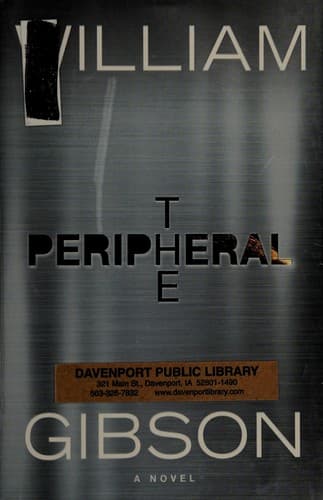
The Peripheral
William Gibson·2014·G. P. Putnam's Sons·Sci-Fi & Fantasy
Reading level: Ages 16+ (adult) · 10-hour read · Advanced difficulty.
- Reading time
- 10h
- Difficulty
- Advanced
- Recommended age
- Ages 16+
- Guide read
- 7min
- Editor's rating
- 4.0 / 5
- science-fiction
- william-gibson
- prime-video-adaptation
- time-travel
- cyberpunk
— In one sentence —
William Gibson's later screen-adapted future, where remote bodies, class collapse, and time itself become a market.
§ 01 · WHY READ
Why read
The Peripheral is William Gibson's later science-fiction novel behind Prime Video's adaptation, and it is a useful companion to Neuromancer because it shows how Gibson's technological anxiety changed. The book is not early cyberpunk neon. It is about remote presence, class separation, economic ruin, and a future wealthy enough to treat other timelines as manipulable.
The premise begins with Flynne Fisher testing what looks like a game. The job turns out to be contact with another reality, and the book's real force comes from the gap between her precarious near future and the colder, richer world reaching back toward her.
Read it if the show made the concept feel sleek but you want the denser Gibson version. The book is demanding, but its difficulty is part of the point: power arrives through systems before anyone fully understands the interface.
§ 02 · CHARACTERS
Characters
Flynne Fisher gives the book its grounded pressure. She is not a chosen hero; she is a smart person inside economic constraint.
Burton and the veterans around Flynne connect the near future to labor, trauma, and survival networks.
Wilf Netherton and the future elite show a world where catastrophe has already been priced into culture, fashion, and control.
§ 03 · HIGHLIGHTS
Three highlights
No. 1 - Remote-body science fiction. The peripheral technology makes embodiment feel political and economic.
No. 2 - Gibson's later style. The book is cooler and more structurally complex than his early cyberpunk work.
No. 3 - Adaptation contrast. Prime Video's version clarifies some plot surfaces, while the novel keeps the systems stranger.
§ 04 · EDITIONS
Recommended editions
| Edition | Why pick it |
|---|---|
| Putnam / Berkley paperback | Standard English availability and stable ISBN trail. |
| Jackpot trilogy editions | Best if you plan to continue into Agency and later entries. |
| Ebook | Useful for searching names and rereading dense sections. |
| Audiobook | Good if Gibson's abrupt transitions slow you down on the page. |
§ 05 · FIT
Who it's for / not for
Read this if you are...
- Curious about the book behind Prime Video's The Peripheral.
- Interested in technology, class, remote work, timelines, and post-collapse wealth.
- Coming from Neuromancer and wanting Gibson's later evolution.
- Comfortable with delayed exposition and dense slang.
Skip it if you are...
- Wanting a simple time-travel thriller.
- Looking for fast, friendly onboarding.
- Expecting the adaptation to match the book scene by scene.
- Sensitive to violence, economic despair, surveillance, and bodily harm.
§ 06 · TIPS
Reading tips
- Let the vocabulary settle. Gibson often explains by repetition and context.
- Track class before timeline mechanics. Money and access matter more than puzzle-box neatness.
- Notice bodies as interfaces. The title is not just tech jargon.
- Read beside the show, not after it mechanically. The book's texture is the main reason to return.
§ 07 · COMPARE
Read alongside
- William Gibson - Neuromancer. The earlier cyberpunk foundation.
- Blake Crouch - Dark Matter. A faster alternate-reality thriller contrast.
- Liu Cixin - The Dark Forest. For civilization-scale technological dread.
- Hugh Howey - Wool. For screen-adapted systems fiction with a clearer mystery frame.
- Isaac Asimov - Foundation. For a colder future-history comparison.
§ 08 · DISCUSSION
Discussion questions
- What makes a peripheral a body, a tool, or a form of labor?
- How does Gibson connect technology to class power?
- Is the future in the book more advanced or more damaged?
- Why does delayed explanation suit this story?
- How does Flynne's economic situation shape her choices?
- What does the adaptation simplify, and what does it gain by doing so?
- Does the timeline premise make the book hopeful or more exploitative?
- How does this later Gibson compare with Neuromancer?
One line to remember
“The Peripheral treats the future as a remote workplace where the richest people can outsource even history.”— bibliotecas editorial summary, not a textual quotation
You might also like
Read next
William Gibson · 1984
Neuromancer
The cyberpunk source novel to read before Apple TV turns cyberspace back into a crime scene.
Read · 7 min
Ted Chiang · 2002
Stories of Your Life and Others
Ted Chiang writes 30-page stories that take longer to think about than most novels. He has won more awards per word than any writer alive.
Read · 5 min
Cixin Liu · 2008
The Dark Forest
Fan + author consensus pick for the best book in the trilogy. Two simple axioms derive the silence of the universe. After this one, you don't look at the night sky the same way.
Read · 5 min