Editor-reviewed
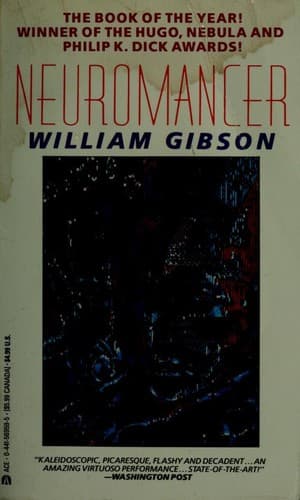
Neuromancer
William Gibson·1984·Ace Books·Sci-Fi & Fantasy
Reading level: Ages 16+ (adult) · 7-hour read · Advanced difficulty.
- Reading time
- 7h
- Difficulty
- Advanced
- Recommended age
- Ages 16+
- Guide read
- 7min
- Editor's rating
- 4.3 / 5
- science-fiction
- cyberpunk
- ai
- hacking
- apple-tv-adaptation
— In one sentence —
The cyberpunk source novel to read before Apple TV turns cyberspace back into a crime scene.
§ 01 · WHY READ
Why read
Neuromancer is the William Gibson novel behind Apple TV's announced 10-episode series, and it is still the sharpest entry point into cyberpunk as a literary mood. The book gave modern readers a version of cyberspace that felt criminal, glamorous, damaged, and corporate all at once.
The plot follows Case, a ruined hacker pulled back into dangerous work, but the appeal is larger than the job. Gibson writes technology as atmosphere: neon, addiction, body modification, artificial intelligence, organized crime, and multinational power all pressing on people who are trying to survive at street level.
Read it before the adaptation because the language is half the experience. The show can visualize the Sprawl, but the book's compressed style is what makes its future feel unstable and alive.
§ 02 · CHARACTERS
Characters
Case is talented, damaged, and desperate enough to be useful to people who should not be trusted.
Molly Millions gives the novel much of its kinetic force. She is bodyguard, fighter, survivor, and one of cyberpunk's defining figures.
Wintermute and the Tessier-Ashpool orbit move the book from heist story into artificial-intelligence myth and corporate gothic.
§ 03 · HIGHLIGHTS
Three highlights
No. 1 - Genre creation. The book did not invent every cyberpunk ingredient, but it made the combination definitive.
No. 2 - Style as world-building. Gibson's sentences make the future feel overloaded before you fully understand it.
No. 3 - Adaptation curiosity. Apple TV's official series announcement makes this a high-value read-before-the-show classic.
§ 04 · EDITIONS
Recommended editions
| Edition | Why pick it |
|---|---|
| Ace mass-market paperback | The familiar English edition and a compact way to read it. |
| Penguin / Ace reissues | Good if you want a newer copy with durable availability. |
| Sprawl trilogy editions | Best if you plan to continue to Count Zero and Mona Lisa Overdrive. |
| Audiobook | Useful if the density slows you down, though the prose rewards rereading. |
§ 05 · FIT
Who it's for / not for
Read this if you are...
- Curious about the source code of cyberpunk.
- Waiting for Apple TV's adaptation and want the original texture first.
- Interested in artificial intelligence, hacking, body modification, and corporate power.
- Comfortable with dense style and minimal hand-holding.
Skip it if you are...
- Looking for clean exposition and gentle onboarding.
- Wanting optimistic technology fiction.
- Frustrated by noir slang, abrupt scene shifts, and older genre assumptions.
- Sensitive to addiction, violence, exploitation, and bodily harm.
§ 06 · TIPS
Reading tips
- Let some details stay strange. Gibson expects immersion before clarity.
- Track power, not gadgets. The technology matters because of who controls it.
- Notice the noir structure. The future is built like a job that keeps going wrong.
- Read slowly when the prose compresses. The style is not decoration; it is the world.
§ 07 · COMPARE
Read alongside
- Blake Crouch - Dark Matter. A cleaner contemporary sci-fi thriller contrast.
- Liu Cixin - The Three-Body Problem. For a very different kind of technology-scale anxiety.
- Ursula K. Le Guin - The Left Hand of Darkness. For classic science fiction with slower anthropological depth.
- Hugh Howey - Wool. For modern screen-adapted dystopian systems.
- William Gibson - Count Zero. The next Sprawl novel if you want more of the world.
§ 08 · DISCUSSION
Discussion questions
- Does Neuromancer feel dated, prophetic, or both?
- Why does Gibson make cyberspace feel physical?
- Is Case free at any point in the novel?
- What makes Molly more than a genre icon?
- How does the book connect corporate power to damaged bodies?
- What should Apple TV prioritize: plot clarity, style, or atmosphere?
- Does the artificial intelligence story feel spiritual, criminal, or political?
- Why has this book remained so influential even when some details became retro?
One line to remember
“Neuromancer makes the future feel less like progress than a market where bodies, data, and memory are all for sale.”— bibliotecas editorial summary, not a textual quotation
You might also like
Read next
William Gibson · 2014
The Peripheral
William Gibson's later screen-adapted future, where remote bodies, class collapse, and time itself become a market.
Read · 7 min
Ted Chiang · 2002
Stories of Your Life and Others
Ted Chiang writes 30-page stories that take longer to think about than most novels. He has won more awards per word than any writer alive.
Read · 5 min
Cixin Liu · 2008
The Dark Forest
Fan + author consensus pick for the best book in the trilogy. Two simple axioms derive the silence of the universe. After this one, you don't look at the night sky the same way.
Read · 5 min