Editor-reviewed
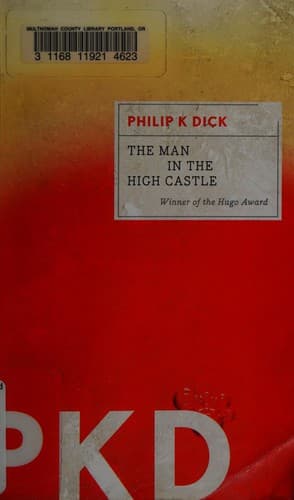
The Man in the High Castle
Philip K. Dick·1962·Putnam·Sci-Fi & Fantasy
Reading level: Ages 15+ (adult) · 6-hour read · moderate difficulty.
- Reading time
- 6h
- Difficulty
- moderate
- Recommended age
- Ages 15+
- Guide read
- 6min
- Editor's rating
- 4.2 / 5
- alternate-history
- science-fiction
- dystopian-fiction
- prime-video-adaptation
- philip-k-dick
— In one sentence —
Philip K. Dick's alternate-history novel behind Prime Video's flagship dystopian series.
§ 01 · WHY READ
Why read
The Man in the High Castle is the Philip K. Dick novel behind Prime Video's alternate-history series. The premise is famous: the Axis powers won World War II, and the United States has been divided under Japanese and German control. The book is stranger than the elevator pitch, though. It is less a resistance adventure than a novel about occupation, commerce, counterfeit objects, divination, and the dangerous comfort of believing one version of reality is stable.
Prime Video's official page identifies the show as based on Dick's award-winning novel. The series expands the plot into a larger television world, while the book keeps its attention on unease: what people buy, sell, hide, read, and pretend not to know when history has gone wrong.
Read it if you want the source before the spectacle. It is short, unsettling, and more philosophical than action-heavy.
§ 02 · CHARACTERS
Characters
Juliana Frink is one of the book's emotional centers, drawn toward a forbidden alternate-history book that unsettles the world she knows.
Robert Childan deals in American antiques for Japanese clients, which makes him a useful lens on taste, power, and humiliation.
Nobusuke Tagomi carries the political and metaphysical weight of the novel. His chapters show Dick's interest in moral pressure as much as world-building.
§ 03 · HIGHLIGHTS
Three highlights
No. 1 - Major adaptation route. Prime Video's series keeps the book visible for readers who know the screen version first.
No. 2 - Compact alternate history. The novel does not need huge length to make its world feel morally unstable.
No. 3 - Philip K. Dick gateway. It introduces his interest in reality, false surfaces, and fragile identity through a recognizable historical premise.
§ 04 · EDITIONS
Recommended editions
| Edition | Why pick it |
|---|---|
| Mariner / Houghton editions | Common modern English editions, including ISBN 9780547572482. |
| Vintage / library copies | Good if you want a cheap reader's copy of a classic science-fiction title. |
| Ebook | Useful for a short, idea-dense read. |
| Audiobook | Works if you can listen closely to the political and philosophical turns. |
§ 05 · FIT
Who it's for / not for
Read this if you are...
- Coming from Prime Video and want Dick's original version.
- Interested in alternate history that stays psychologically uneasy.
- Looking for a short classic with more ideas than action scenes.
- Curious about Philip K. Dick beyond his better-known film adaptations.
Skip it if you are...
- Wanting the full resistance-plot scale of the TV series.
- Avoiding Nazi occupation, racism, antisemitism, and wartime counterfactuals.
- Looking for tidy world-building rules.
- Frustrated by ambiguous endings and philosophical turns.
§ 06 · TIPS
Reading tips
- Expect a different rhythm from the show. The book is quieter and odder than the series.
- Watch the objects. Antiques, fakes, and collectibles say a lot about occupation and power.
- Notice the book inside the book. The Grasshopper Lies Heavy is central to the novel's reality problem.
- Read for unease, not plot conquest. Dick is more interested in doubt than victory.
§ 07 · COMPARE
Read alongside
- Philip K. Dick - Do Androids Dream of Electric Sheep? External follow-up for another Dick source behind a major screen adaptation.
- George Orwell - 1984. For state control and fear in a different dystopian register.
- Yevgeny Zamyatin - We. For an older dystopian benchmark.
- Frank Herbert - Dune. For another classic science-fiction text with a large screen afterlife.
- Isaac Asimov - Foundation. For a different kind of science-fiction classic adapted by a streaming platform.
§ 08 · DISCUSSION
Discussion questions
- Why does the book feel unsettling even when little action is happening?
- How do objects and antiques become political?
- What does The Grasshopper Lies Heavy do inside the story?
- How does Dick use the I Ching to shape uncertainty?
- What does Prime Video gain by expanding this premise into a series?
- Is the novel more about history, reality, or identity?
- Which character most clearly understands the world they live in?
- Does the ending clarify the book or deepen the doubt?
One line to remember
“In an occupied America where the Axis powers won World War II, forbidden stories become a way to question reality itself.”— bibliotecas editorial summary, not a textual quotation
You might also like
Read next
Ted Chiang · 2002
Stories of Your Life and Others
Ted Chiang writes 30-page stories that take longer to think about than most novels. He has won more awards per word than any writer alive.
Read · 5 min
Cixin Liu · 2008
The Dark Forest
Fan + author consensus pick for the best book in the trilogy. Two simple axioms derive the silence of the universe. After this one, you don't look at the night sky the same way.
Read · 5 min
Octavia E. Butler · 1979
Kindred
Octavia Butler sends a Black woman from 1976 Los Angeles back to antebellum Maryland. The time travel is a device. The horror is real.
Read · 5 min