Editor-reviewed
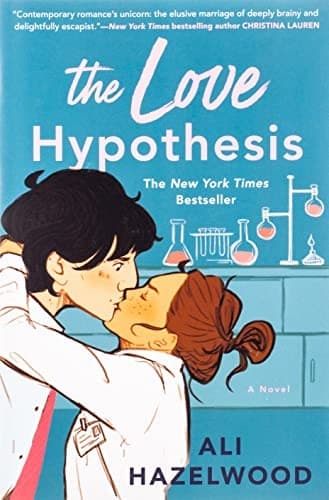
The Love Hypothesis
Ali Hazelwood·2021·Berkley·romance
Reading level: Ages 16+ (adult) · 7-hour read · Beginner difficulty.
- Reading time
- 7h
- Difficulty
- Beginner
- Recommended age
- Ages 16+
- Guide read
- 6min
- Editor's rating
- 4.0 / 5
- romance
- fake-dating
- stem-romance
- academic-romance
- booktok
- prime-video-adaptation
— In one sentence —
The fake-dating STEM romance behind Prime Video's film adaptation, and still Ali Hazelwood's clearest entry point.
§ 01 · WHY READ
Why read
The Love Hypothesis is the book to pick up if the Prime Video adaptation has put Ali Hazelwood's lab-coat romance back in your feed and you want the original version of the fake-dating setup. Olive Smith is a biology PhD student who needs one impulsive kiss to look convincing. Adam Carlsen is the intimidating professor who agrees to keep pretending. The hook is simple, but Hazelwood turns it into a low-friction romance about ambition, insecurity, mentorship, and how hard it is to trust good news when academia keeps training you for rejection.
The novel became a BookTok-scale hit because it is unusually easy to explain: STEM workplace, grumpy/sunshine energy, fake dating, slow emotional thaw, and a heroine who is competent without feeling invulnerable. It is not a documentary about graduate school. It is a romance that uses the pressure of labs, funding, conferences, and reputational anxiety to make the central relationship feel boxed in.
Prime Video's official materials identify the film as adapted from Hazelwood's novel, so this is the correct source read for viewers who want the page version before or after watching. The best reason to read it now is not completism; it is to decide whether Hazelwood's mix of banter, academic stress, and comfort-reading payoff is your lane.
§ 02 · CHARACTERS
Characters
Olive Smith is smart, tired, underfunded, and more emotionally transparent than she wants to be. Her best scenes are not the ones where she solves science problems; they are the moments when she admits how much she has built her life around not needing too much from anyone.
Adam Carlsen begins as the department's feared genius. The romance works by slowly replacing that public image with a quieter person who listens, remembers, and understands professional pressure better than Olive expects.
The academic circle gives the book its stakes. Friends, advisors, rivals, and conference spaces make the fake relationship visible enough that the lie has consequences.
§ 03 · HIGHLIGHTS
Three highlights
No. 1 · Trope clarity. The book knows exactly what readers came for: fake dating, forced proximity, public awkwardness, and private tenderness.
No. 2 · A strong reader-decision shape. If you want to know whether STEM romance is for you, this is a clean test case: accessible, emotionally direct, and fast to finish.
No. 3 · Adaptation timing. The official Prime Video film route gives new readers a practical reason to start here rather than wander through Hazelwood's later catalog first.
§ 04 · EDITIONS
Recommended editions
| Edition | Why pick it |
|---|---|
| Berkley paperback | The standard English edition and the easiest first copy to find. |
| Movie tie-in edition | Useful if you are reading alongside the Prime Video adaptation window. |
| Ebook | Best for the quick, binge-readable pace. |
| Audiobook | A good fit if you want the awkward banter and emotional beats foregrounded. |
§ 05 · FIT
Who it's for / not for
Read this if you are...
- Coming from the Prime Video film and want the original Olive-and-Adam story.
- Looking for fake dating, STEM workplace romance, and a comforting payoff.
- A romance reader who likes high trope visibility more than surprise.
- Curious why Hazelwood became a major contemporary-romance name.
Skip it if you are...
- Looking for a realistic campus-policy novel.
- Uncomfortable with professor/graduate-student power dynamics, even in a fictionalized romance frame.
- Wanting literary prose or a slow, ambiguous ending.
- Tired of grumpy/sunshine and fake-dating conventions.
§ 06 · TIPS
Reading tips
- Read for emotional mechanics, not academic realism. The lab setting creates pressure; the romance remains the main event.
- Watch the friendship stakes. Olive's first lie is about protecting a friend, which keeps the plot from being only flirtation.
- Expect comfort more than chaos. The book has conflict, but its promise is reassurance.
- Continue by trope. If you like the tone, Hazelwood's later books are easy to navigate by setup and workplace.
§ 07 · COMPARE
Read alongside
- Elle Kennedy — The Deal. Another screen-adaptation romance where a bargain turns into real intimacy.
- Emily Henry — People We Meet on Vacation. More polished banter and a slower friends-to-lovers ache.
- Colleen Hoover — It Ends with Us. For a much heavier mainstream romance phenomenon.
- Jane Austen — Pride and Prejudice. The durable ancestor for misread confidence and public misunderstanding.
- Jojo Moyes — Me Before You. If you want romance with a larger emotional cost.
§ 08 · DISCUSSION
Discussion questions
- Does the fake-dating premise make Olive more honest or more guarded?
- How does the academic setting change the power balance of the romance?
- Is Adam appealing because he changes, or because Olive sees more than others do?
- Where does the book feel most like comfort reading?
- What should an adaptation preserve: the lab world, the banter, or the private emotional turns?
- Does the novel need surprise, or is familiarity part of the pleasure?
- How does Olive's professional insecurity shape her romantic choices?
- Would the story work outside academia?
One line to remember
“A graduate student's fake relationship with a famously difficult professor becomes a bright, trope-forward academic romance.”— bibliotecas editorial summary, not a textual quotation
You might also like
Read next
Diana Gabaldon · 1991
Outlander
A nine-hundred-page time-travel romance written by a quantitative ecologist who decided, at thirty-five, to try writing a novel.
Read · 7 min
Carley Fortune · 2022
Every Summer After
The first-love summer romance behind Prime Video's Every Year After, told across six summers and one charged return.
Read · 6 min
Jojo Moyes · 2012
Me Before You
A romance about class, caretaking, and an ending that the disability community has been correctly arguing with for over a decade.
Read · 6 min