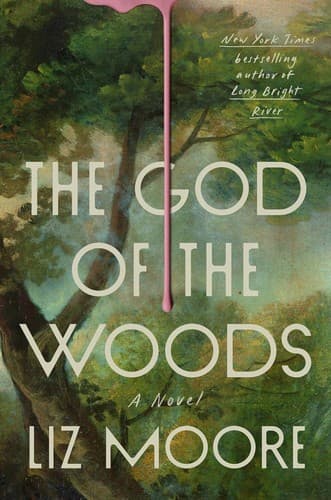
Editor-reviewed
The God of the Woods
Liz Moore·2024·Riverhead Books·thriller
Reading level: Ages 16+ (adult) · 10-hour read · Intermediate difficulty.
- Reading time
- 10h
- Difficulty
- Intermediate
- Recommended age
- Ages 16+
- Guide read
- 7min
- Editor's rating
- 4.3 / 5
- mystery
- literary-thriller
- family-secrets
- netflix-adaptation
- book-club
— In one sentence —
A layered Adirondack missing-person mystery to read before Netflix turns Liz Moore's bestseller into a drama series.
§ 01 · WHY READ
Why read
The God of the Woods is a literary mystery with a strong commercial hook: in 1975, a teenage girl disappears from an Adirondack summer camp owned by her wealthy family. That loss echoes an earlier family tragedy, and Liz Moore uses the search to move through class, secrecy, inheritance, and the people who work in the shadow of privilege.
Netflix has ordered a series adaptation of Moore's bestselling novel, with current casting and production news keeping the screen window active. The book is a strong source read because its value is not only "what happened?" It is how the answer depends on power, silence, and the different worlds clustered around the same woods.
This is a good fit for readers who want mystery momentum but do not want a disposable thriller. It is built for book clubs, adaptation watchers, and readers who like family secrets with social texture.
§ 02 · CHARACTERS
Characters
Barbara Van Laar is the missing girl whose absence reorganizes everyone else's story.
The Van Laar family represents money, control, and the habit of turning private tragedy into managed narrative.
The camp staff, investigators, and local community keep the book from becoming only a rich-family mystery. Their proximity to the Van Laars gives the novel its class tension.
§ 03 · HIGHLIGHTS
Three highlights
No. 1 - A strong premise with depth. A missing camper is the hook; the social world around the disappearance is the substance.
No. 2 - Adaptation-ready structure. Multiple timelines, a summer-camp setting, and a large ensemble give Netflix obvious dramatic material.
No. 3 - Book-club crossover. The novel can satisfy thriller readers and literary-fiction readers at the same time.
§ 04 · EDITIONS
Recommended editions
| Edition | Why pick it |
|---|---|
| Riverhead hardcover | The standard English edition and clearest bibliographic match. |
| Paperback / trade edition | Best for book clubs once widely available. |
| Ebook | Useful for keeping the long cast and timelines searchable. |
| Audiobook | Good if you like layered mysteries in sustained listening blocks. |
§ 05 · FIT
Who it's for / not for
Read this if you are...
- Looking for a mystery with literary weight.
- Interested in class, family power, and summer-camp atmosphere.
- Tracking Netflix literary-thriller adaptations.
- Choosing a discussion-friendly book-club thriller.
Skip it if you are...
- Wanting a short, purely twist-driven thriller.
- Impatient with multiple timelines and ensemble structure.
- Looking for cozy mystery comfort.
- Sensitive to missing-child plots.
§ 06 · TIPS
Reading tips
- Keep the timelines straight. The book's emotional force depends on how past and present speak to each other.
- Watch class details. Who owns the land and who serves it matters.
- Do not reduce it to the solution. The mystery matters, but the social map is the point.
- Read before screen coverage gets louder. Adaptation casting can reshape how you imagine the characters.
§ 07 · COMPARE
Read alongside
- Alice Feeney - His & Hers. For another screen-bound mystery with a strong central puzzle.
- Richard Osman - The Thursday Murder Club. For a lighter mystery contrast.
- Liane Moriarty - Big Little Lies. For ensemble secrets and screen-adapted domestic suspense.
- Tana French - In the Woods. External read-alike for missing-child mystery and atmosphere.
- Donna Tartt - The Secret History. External read-alike for privilege, secrecy, and literary suspense.
§ 08 · DISCUSSION
Discussion questions
- Does the missing-person plot or the class structure drive the book more?
- How does the Adirondack setting shape the story's moral atmosphere?
- Which characters benefit from silence?
- Does the novel treat wealth as protection, corruption, or both?
- What should a Netflix adaptation avoid simplifying?
- How does the summer-camp setting change the stakes?
- Is the book more mystery, family saga, or social novel?
- Does the ending change how you read the earlier chapters?
One line to remember
“A summer-camp disappearance opens a family dynasty, a working community, and an old wound at the same time.”— bibliotecas editorial summary, not a textual quotation
You might also like
Read next
Liz Moore · 2020
Long Bright River
Liz Moore's Philadelphia crime novel behind Peacock's Amanda Seyfried limited series.
Read · 6 min
Agatha Christie · 1939
And Then There Were None
Ten strangers, one isolated island, and the cleanest demonstration in mystery fiction that a simple setup can still produce unbearable tension.
Read · 6 min
Daphne du Maurier · 1938
Rebecca
A second marriage, a country house, and a dead woman who seems more alive than everyone around her: du Maurier turns jealousy into one of the great slow-burn suspense novels.
Read · 6 min