Editor-reviewed
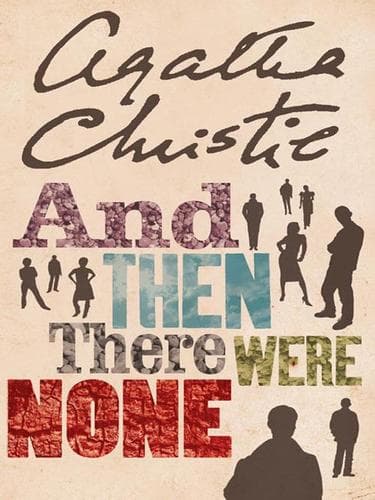
And Then There Were None
Agatha Christie·1939·HarperCollins·thriller
Reading level: Ages 14+ (adult) · 6-hour read · Beginner difficulty.
- Reading time
- 6h
- Difficulty
- Beginner
- Recommended age
- Ages 14+
- Guide read
- 6min
- Editor's rating
- 4.8 / 5
- classic-mystery
- locked-island
- whodunit
- fair-play
- isolation
- multiple-suspects
- golden-age-crime
— In one sentence —
Ten strangers, one isolated island, and the cleanest demonstration in mystery fiction that a simple setup can still produce unbearable tension.
§ 01 · WHY READ
Why read
And Then There Were None is one of those rare classics that still works almost exactly the way new readers hope it will. The premise is brutally simple: ten strangers are invited to an isolated island, accused of past crimes, and begin dying one by one. The island setting removes escape routes, the head count keeps shrinking, and every surviving person becomes both suspect and potential victim. If someone says they want a mystery that is easy to start, impossible to put down, and foundational without feeling like homework, this is one of the safest recommendations in the genre.
Agatha Christie's technical control is the reason. She does not need baroque prose, deep psychological excavation, or a large social canvas. She needs a closed system, an exact rhythm of accusation and fear, and a solution that feels inevitable only after you arrive at it. That economy is why the novel remains so useful for beginner readers: the book is short, the stakes are legible from page one, and the suspense keeps tightening instead of diffusing.
There is one context point modern readers should know in advance. The novel's original 1939 UK title used a racist slur taken from a minstrel-song rhyme. Modern editions rightly use And Then There Were None, and later printings also revise the rhyme and related wording. That publishing history matters and should not be ignored, but it does not cancel the novel's importance. For bibliotecas, this is both a Batch 1 thriller/mystery anchor and a clean beginner-safe addition for best-thrillers-for-beginners: classic, fast, high-recognition, and still structurally satisfying.
§ 02 · CHARACTERS
Characters
The cast is designed less for intimacy than for pressure. Christie wants the group dynamic to become the machine.
Vera Claythorne - intelligent, capable, and among the quickest to grasp the danger. Vera is often the emotional center because panic, guilt, and self-command all register sharply through her.
Philip Lombard - worldly, evasive, and immediately suspicious in a way that may or may not be justified. Lombard helps keep the group from settling into false certainty.
Justice Wargrave - retired judge, calm observer, and one of the novel's key voices of rationality. Christie knows exactly how much authority a figure like Wargrave carries inside a closed-room panic.
Dr Armstrong, Emily Brent, General MacArthur, Anthony Marston, the Rogerses, and William Blore - a deliberately varied group of people united by secrets they would rather not examine. Christie makes the differences between them matter just enough for the suspicion network to keep shifting.
The island itself - not a character in the literary-novel sense, but absolutely part of the mechanism. Isolation is the book's greatest accomplice.
§ 03 · HIGHLIGHTS
Three highlights
No. 1 - The setup is instantly legible. You do not need to memorize a family tree, a police hierarchy, or a fantasy map. Ten people are trapped. They begin to die. That clarity is a major reason the novel still converts new mystery readers.
No. 2 - Christie turns suspicion into atmosphere. The book gets scarier not because the murders are graphically described, but because trust becomes mathematically impossible. Every conversation is contaminated by the fact that someone in the room is lying.
No. 3 - The solution is a masterclass in construction. Even readers who guess pieces of the method usually miss the full design. Christie earns her reputation here not through stylistic flourish but through precision.
§ 04 · EDITIONS
Recommended editions
| Edition | Why pick it |
|---|---|
| HarperCollins paperback / trade paperback | The easiest modern edition to find and a straightforward recommendation for contemporary readers. |
| William Morrow / Harper US reprints | Good US-market copies if you want a stable in-print version under the modern title. |
| Audiobook editions | A strong option because the suspect list and shifting suspicion are easy to follow aloud when the narration is clear. |
If you care about textual history, note which edition you are reading. Modern editions generally use the current title and revised rhyme language; older editions may preserve wording that now requires context.
§ 05 · FIT
Who it's for / not for
Read this if you are...
- New to mystery or thriller fiction and want a near-canonical starting point that still moves fast.
- Looking for a classic that reads cleanly and does not ask for much patience before the hook lands.
- Curious about the closed-circle / isolated-suspects structure that so many later books and films borrow.
- Building toward
best-thrillers-for-beginnersand needing a recognizable classic that complements the more contemporary domestic and psychological entries.
Skip it if you are...
- Looking for rich interior literary prose rather than plot precision.
- Highly sensitive to a book's racist publication history and do not want to engage with that context, even in revised editions.
- Wanting a detective protagonist to follow. The pleasure here comes from group paranoia, not from attaching yourself to one brilliant investigator.
- Needing modern realism about policing, trauma, or social context. Christie is building a formal machine first.
§ 06 · TIPS
Reading tips
- Read the edition notes if they are provided. The title and rhyme history matter, and knowing that context makes the reading cleaner rather than heavier.
- Do not overcomplicate the experience. This is a short book built for propulsion. Trust the setup and let it do its work.
- Keep the rhyme in mind. Christie uses it as both plot engine and pressure device; the pattern is part of the fun.
- Notice how often certainty collapses. Each apparent solution creates a new impossibility, which is the whole point.
- This is an ideal "read it in one weekend" mystery. The shrinking-suspect structure lands best when you do not leave large gaps between chapters.
§ 07 · COMPARE
Read alongside
- Agatha Christie - The Murder of Roger Ackroyd (1926). Another foundational Christie puzzle if you want to see a different version of her formal ingenuity.
- Agatha Christie - Murder on the Orient Express (1934). A more famous ensemble mystery for readers who enjoy suspects trapped inside a closed environment.
- Daphne du Maurier - Rebecca (1938). Not a detective novel, but an excellent companion if you want another 1930s suspense classic that works through dread and manipulation.
- Alex Michaelides - The Silent Patient (2019). A modern page-turner that inherits some of its twist-fairness ambitions from the Christie tradition.
- Lucy Foley - The Guest List (2020). A contemporary island-set ensemble thriller whose appeal makes more sense once you have read Christie's closed-circle template.
§ 08 · DISCUSSION
Discussion questions
- Why is the island setting so effective? What kinds of explanation become impossible once the group is cut off?
- Does the novel create fear mainly through the murders themselves or through the destruction of trust?
- Which character do you think Christie uses most effectively as a decoy for reader suspicion?
- How does the nursery-rhyme structure shape your experience of inevitability? Does it make the book feel more artificial or more intense?
- Should a modern reader separate the novel's formal brilliance from its racist publication history, or is that separation too easy?
- Christie gives most characters only limited depth compared with a modern literary thriller. Is that a weakness, or part of the book's efficiency?
- At what point did you stop thinking the group could solve the problem rationally?
- Why do so many later thrillers keep returning to the "closed set of suspects" design this novel perfected?
One line to remember
“Ten little soldier boys went out to dine.”— Nursery rhyme used in later editions
You might also like
Read next
Agatha Christie · 1929
The Seven Dials Mystery
Christie's Bundle Brent mystery behind Netflix's Seven Dials.
Read · 6 min
Daphne du Maurier · 1938
Rebecca
A second marriage, a country house, and a dead woman who seems more alive than everyone around her: du Maurier turns jealousy into one of the great slow-burn suspense novels.
Read · 6 min
John le Carre · 1974
Tinker Tailor Soldier Spy
John le Carre's George Smiley mole hunt, the source novel behind the BBC series and 2011 film.
Read · 6 min