Editor-reviewed
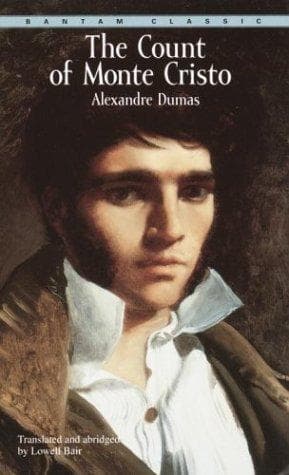
The Count of Monte Cristo
Alexandre Dumas·1844·Bantam Classics·Literature
Reading level: Ages 14+ (adult) · 45-hour read · Advanced difficulty.
- Reading time
- 45h
- Difficulty
- Advanced
- Recommended age
- Ages 14+
- Guide read
- 6min
- Editor's rating
- 4.8 / 5
- alexandre-dumas
- french-literature
- revenge
- adventure
- pbs-masterpiece
— In one sentence —
Dumas's revenge epic, newly visible through the PBS Masterpiece adaptation starring Sam Claflin.
§ 01 · WHY READ
Why read
The Count of Monte Cristo is Alexandre Dumas's revenge novel about Edmond Dantes, a sailor falsely imprisoned and remade by escape, wealth, patience, and obsession. PBS Masterpiece describes its new series as a TV adaptation of Dumas's novel, and Penguin Random House lists the Bantam Classics English edition with ISBN 9780553213508.
The book is long because revenge takes time. Dumas lets Dantes disappear, learn, return, and test everyone who profited from his ruin. The pleasure is not only the payoff. It is watching a person turn pain into performance and then discovering what that performance costs him.
Read it before the PBS series if you want the full architecture of betrayal, disguise, and delayed consequence. Skip it if you need a lean thriller. This is a serial novel with patience built into the engine.
§ 02 · CHARACTERS
Characters
Edmond Dantes begins as a young sailor with a future. Prison turns him into the Count, a man who can wait years for a plan to close.
Abbe Faria gives Dantes knowledge, discipline, and the possibility of escape.
Fernand, Danglars, and Villefort each benefit from Dantes's fall in a different way, which gives the revenge plot its social range.
Mercedes is the emotional test that revenge cannot fully solve.
§ 03 · HIGHLIGHTS
Three highlights
No. 1 - Current PBS window. PBS Masterpiece keeps the novel visible through its new Sam Claflin adaptation.
No. 2 - Classic with plot drive. It has the cultural weight of a classic but the forward motion of a revenge thriller.
No. 3 - Adaptation contrast. A series can streamline the story, but the book shows the slow moral change in Dantes.
§ 04 · EDITIONS
Recommended editions
| Edition | Why pick it |
|---|---|
| Bantam Classics paperback | Compact English edition with ISBN 9780553213508. |
| Penguin Classics translation | Strong unabridged route if you want a fuller modern text. |
| Vintage Classics paperback | Good long-read format for readers outside the US market. |
| Audiobook | Useful if the length is the main barrier. |
§ 05 · FIT
Who it's for / not for
Read this if you are...
- Watching or planning to watch PBS Masterpiece's The Count of Monte Cristo.
- Looking for a revenge story with patience, disguises, and social scale.
- Interested in classics that still move like popular fiction.
- Willing to read a long book for a big payoff.
Skip it if you are...
- Avoiding imprisonment, betrayal, violence, or obsessive revenge.
- Looking for psychological realism above plot.
- Unwilling to track many aliases, households, and long-delayed consequences.
- Hoping for a short before-the-show read.
§ 06 · TIPS
Reading tips
- Read for setup. Early chapters plant debts that return much later.
- Keep a name list. Dumas uses identity shifts and social positions as plot tools.
- Do not rush the middle. The novel's moral pressure builds while the plan seems to widen.
- Compare pacing after watching. The PBS series will have to choose what to compress.
§ 07 · COMPARE
Read alongside
- Victor Hugo - Les Miserables. Another French classic where law, mercy, and social punishment collide.
- Alexandre Dumas - The Three Musketeers. External follow-up if you want Dumas in faster adventure mode.
- Charlotte Bronte - Jane Eyre. For secrets, inheritance, and moral self-possession in a different register.
- Wilkie Collins - The Woman in White. For Victorian plotting, conspiracy, and narrative reveals.
- Emily Bronte - Wuthering Heights. For another story about grievance that outlives its original injury.
§ 08 · DISCUSSION
Discussion questions
- When does Dantes stop seeking justice and start seeking control?
- Which betrayal matters most to the shape of the revenge?
- Does the novel admire the Count, fear him, or both?
- How should an adaptation handle the book's length?
- What does wealth let Dantes do that law could not?
- Is Mercedes a reminder of the old Edmond or part of the punishment?
- Where does the novel make revenge feel satisfying?
- Where does it make revenge feel spiritually expensive?
One line to remember
“Edmond Dantes loses his future to a conspiracy, then rebuilds himself into the instrument of his own revenge.”— bibliotecas editorial summary, not a textual quotation
You might also like
Read next
Alexandre Dumas · 1844
The Count of Monte Cristo
The most purely enjoyable long novel ever written. Wrongly imprisoned for years, Edmond Dantès acquires a fortune and destroys the three men who betrayed him with a plotting so elaborate and satisfying it takes 1,200 pages and leaves you wanting more.
Read · 5 min
William Faulkner · 1936
Absalom, Absalom!
Four narrators reconstruct a man who destroyed his family. The story keeps changing. That is the point.
Read · 7 min
Toni Morrison · 1987
Beloved
Toni Morrison said she wrote this novel to give voice to the sixty million. It won the Pulitzer, the Nobel, and is the greatest American novel of the second half of the twentieth century.
Read · 6 min