Editor-reviewed
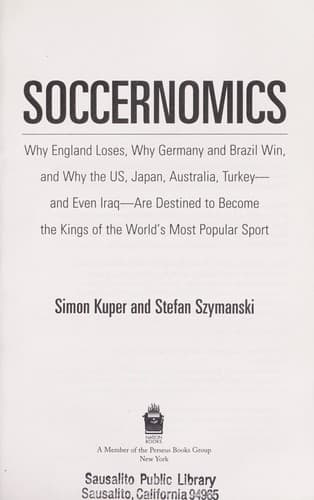
Soccernomics
Simon Kuper and Stefan Szymanski·2009·Nation Books·Sports
Reading level: Ages 15+ (adult) · 9-hour read · Beginner difficulty.
- Reading time
- 9h
- Difficulty
- Beginner
- Recommended age
- Ages 15+
- Guide read
- 4min
- Editor's rating
- 4.4 / 5
- soccer
- football-economics
- sports-business
- world-cup
- data
— In one sentence —
A data-and-economics football book about transfers, overperformance, national teams, markets, and bad assumptions.
§ 01 · WHY READ
Why read
Soccernomics is the antidote to purely romantic football writing. Simon Kuper and Stefan Szymanski ask why clubs waste money, which countries overperform, how transfers get mispriced, and what football looks like when you treat it as an economic system.
The value is not that every argument should be treated as the final word. The value is the habit of questioning inherited football wisdom. Around a World Cup, that is useful: everyone has a theory about why countries win, choke, overachieve, or disappoint.
§ 02 · CHARACTERS
Characters / people
The main characters are clubs, countries, executives, fans, transfer markets, national economies, and the authors' data-driven questions.
§ 03 · HIGHLIGHTS
Three highlights
No. 1 - It punctures cliches. Football's common sense often turns out to be expensive nonsense.
No. 2 - It explains national overperformance. World Cup debates become more interesting with demographic and economic context.
No. 3 - It is readable. The book is analytical without becoming a textbook.
§ 04 · EDITIONS
Recommended editions
| Edition | Why pick it |
|---|---|
| Updated paperback | Best choice because football economics changes quickly. |
| Ebook | Useful for searching countries, clubs, and claims. |
§ 05 · FIT
Who it's for / not for
Read this if you like sports, business, data, or contrarian explanations. Skip it if you want lyrical fan writing, a player memoir, or tactical diagrams.
§ 06 · TIPS
Reading tips
Treat it as a set of arguments to test, not commandments. The best reading mode is skeptical curiosity.
§ 07 · COMPARE
Read alongside
- Jonathan Wilson - Inverting the Pyramid. Tactics instead of economics.
- Franklin Foer - How Soccer Explains the World. Politics and identity.
- Alex Ferguson - My Autobiography. Management from the inside.
§ 08 · DISCUSSION
Discussion questions
- Which football assumption does the book challenge most convincingly?
- Does data make the sport feel clearer or less human?
- How should fans balance romance and evidence?
One line to remember
“The football book for readers who want incentives, markets, and data beside the romance.”— bibliotecas editorial note
Appears in collections
Reading lists featuring this book
You might also like
Read next
Jonathan Wilson · 2008
Inverting the Pyramid
The classic modern tactics history for readers who want to understand what is happening on the pitch.
Read · 5 min
David Goldblatt · 2006
The Ball Is Round
A huge global history of football: empire, class, clubs, migration, money, nationalism, and the World Cup.
Read · 5 min
Eduardo Galeano · 1995
Soccer in Sun and Shadow
A short, literary football classic for readers who want the game as memory, politics, beauty, and ache.
Read · 4 min