Editor-reviewed
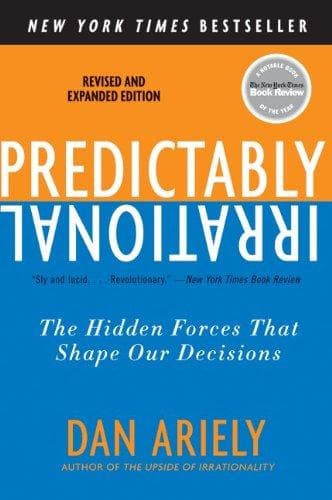
Predictably Irrational
Dan Ariely·2008·Harper Perennial·Psychology
Reading level: Ages 15+ (adult) · 7-hour read · moderate difficulty.
- Reading time
- 7h
- Difficulty
- moderate
- Recommended age
- Ages 15+
- Guide read
- 6min
- Editor's rating
- 3.7 / 5
- dan-ariely
- behavioral-economics
- decision-making
- nbc
- peacock
— In one sentence —
Dan Ariely's behavioral-economics bestseller, and the nonfiction source behind NBC and Peacock's The Irrational.
§ 01 · WHY READ
Why read
Predictably Irrational is Dan Ariely's popular behavioral-economics book about the patterns behind bad decisions. NBCUniversal identifies The Irrational as based on Ariely's book, and Duke's publication record lists the revised and expanded edition with ISBN 9780061353246.
The book is written for general readers, not specialists. Ariely moves through experiments and everyday examples about pricing, expectations, honesty, arousal, free offers, and social norms. The best use is as a map of questions to ask about your own choices, not as a final word on every psychological claim.
Read it before the NBC and Peacock series if you want the nonfiction source behind the premise. Skip it if you want a police procedural source novel or a current academic textbook on decision science.
§ 02 · CHARACTERS
Characters
Dan Ariely is the researcher and narrator, moving between experiments, personal examples, and behavioral-economics claims.
The decision-maker is the book's real subject: a person who thinks a choice is rational, then gets nudged by comparison, price, desire, or habit.
The market designer is the retailer, institution, or rule-maker who shapes the options before anyone chooses.
The experimenter is the recurring presence behind the book's tests, trying to make hidden decision frames visible.
§ 03 · HIGHLIGHTS
Three highlights
No. 1 - Direct NBC source route. NBCUniversal connects The Irrational to Ariely's book.
No. 2 - Clear reader job. The book helps readers notice hidden decision frames in daily life.
No. 3 - Useful caveat built in. It is strongest as a popular entry point, and readers should treat the research field as evolving.
§ 04 · EDITIONS
Recommended editions
| Edition | Why pick it |
|---|---|
| Harper Perennial revised paperback | Current expanded route with ISBN 9780061353246. |
| Original Harper edition | Useful if you want the first 2008 context. |
| Ebook | Good for dipping into examples chapter by chapter. |
| Audiobook | Works well if you prefer nonfiction examples. |
§ 05 · FIT
Who it's for / not for
Read this if you are...
- Coming from NBC or Peacock's The Irrational.
- Looking for accessible behavioral economics.
- Interested in why people make inconsistent choices.
- Building a psychology or decision-making shelf.
Skip it if you are...
- Wanting a crime novel.
- Looking for a current graduate-level psychology text.
- Uncomfortable with pop-science examples that need careful follow-up.
- Expecting the show and book to share plot or characters.
§ 06 · TIPS
Reading tips
- Read with a skeptical pencil. Use the examples as prompts, then check current research when a claim matters.
- Separate source from adaptation. The show borrows the behavioral-science premise, not a nonfiction plot.
- Watch for your own defaults. The book is most useful when you test its ideas against ordinary decisions.
- Pair it with stronger academic anchors. Kahneman, Cialdini, and newer replication-aware psychology help round it out.
§ 07 · COMPARE
Read alongside
- Daniel Kahneman - Thinking, Fast and Slow. For the heavier decision-science anchor.
- Robert Cialdini - Influence. For persuasion and social psychology with practical examples.
- Charles Duhigg - The Power of Habit. For behavior-change framing in a more journalistic mode.
- Michael Lewis - The Undoing Project. For the Kahneman and Tversky story behind modern behavioral economics.
- Nassim Nicholas Taleb - Fooled by Randomness. For a sharper, more skeptical book about error and uncertainty.
§ 08 · DISCUSSION
Discussion questions
- Which example from the book feels most recognizable in daily life?
- When does popular psychology help, and when does it oversimplify?
- How should readers handle older behavioral-economics claims after the replication crisis?
- Does calling choices "irrational" clarify behavior or judge it too quickly?
- What changes when money enters a social situation?
- Why is "free" so powerful as a decision frame?
- How much can a drama series borrow from a nonfiction source?
- What would you verify before using the book's claims at work?
One line to remember
“Ariely argues that human decisions are often irrational in repeatable patterns, especially around price, pain, desire, and social norms.”— bibliotecas editorial summary, not a textual quotation
You might also like
Read next
Viktor Frankl · 1946
Man's Search for Meaning
A concentration-camp memoir and a clinical psychology in one short book. The memoir is unforgettable. The psychology has been thinned by misuse — read it back into context.
Read · 6 min
Giuseppe Tomasi di Lampedusa · 1958
The Leopard
The Sicilian classic behind Netflix's Italian limited series.
Read · 6 min
Octavia E. Butler · 1979
Kindred
Octavia Butler sends a Black woman from 1976 Los Angeles back to antebellum Maryland. The time travel is a device. The horror is real.
Read · 5 min