Editor-reviewed
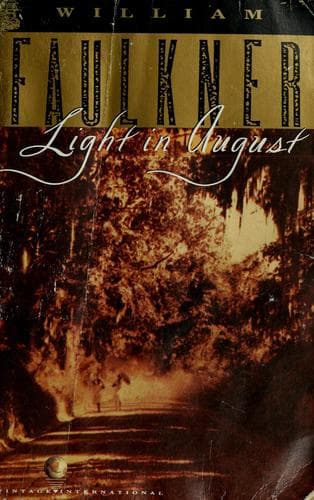
Light in August
William Faulkner·1932·Harrison Smith and Robert Haas·Literature
Reading level: Ages 16+ (adult) · 13-hour read · Advanced difficulty.
- Reading time
- 13h
- Difficulty
- Advanced
- Recommended age
- Ages 16+
- Guide read
- 6min
- Editor's rating
- 4.7 / 5
- faulkner
- american-literature
- southern-gothic
- classic
- race
- identity
— In one sentence —
A man who does not know his race. A pregnant woman looking for her lover. A community that destroys what it cannot categorize.
§ 01 · WHY READ
Why read
Light in August is the most accessible of Faulkner's major novels and the one with the most direct argument about race in America. It tells three stories that run parallel and eventually intersect: Joe Christmas, a man who does not know whether he has Black ancestry and cannot function in a world that requires him to choose; Lena Grove, a young woman from Alabama walking to Mississippi looking for the father of her unborn child; and Reverend Gail Hightower, a man destroyed by his obsession with the Confederate past.
Joe Christmas is the central figure, and his story is an anatomy of how racial categorization destroys people. He was raised in an orphanage, his racial background unknown even to himself. He has lived his life moving between white and Black communities, claiming each identity strategically, belonging to neither. The South in 1932 requires every person to be one or the other; the inability to be categorized is more threatening than being Black, because it cannot be processed by the system that organizes everything around that distinction.
Faulkner is not writing protest fiction. He is doing something more disturbing: showing the machinery of racial identity working, in detail, from the inside of the people it grinds up. The novel does not arrive at a political conclusion. It ends with an image of life continuing — Lena's child, born, moving forward — that refuses to be consoling about anything that happened before it.
The title refers to the quality of light in Mississippi in August: a particular brightness that arrives in the afternoon, luminous and somehow at a distance from the summer's heat. It is the most beautiful title Faulkner found for anything.
§ 02 · CHARACTERS
Characters
Joe Christmas — thirty-three years old when the novel begins (the age is not accidental). He does not know his racial background; his grandfather, an extreme racist, may have been Black. He has spent his life in a particular kind of violence: toward himself and others, provoked by a world that cannot absorb his ambiguity. His sections — told in deep interiority — are the novel's most demanding and most rewarding.
Lena Grove — walking from Alabama to Mississippi, heavily pregnant, certain she will find the man who fathered her child. She is the novel's other center: serene, uncomplicated, effective in a way that has nothing to do with intelligence and everything to do with the basic vitality that Joe Christmas lacks completely. Her parallel story feels like a different novel; Faulkner puts them together because that contrast is the argument.
Reverend Gail Hightower — a minister whose obsession with his Confederate grandfather's death led to his wife's breakdown and suicide, his congregation's rejection, and thirty years of living as the town's ghost. He is the novel's portrait of how the Southern past consumes the living.
Percy Grimm — the young National Guardsman who hunts Joe Christmas at the novel's end. He is the most disturbing character Faulkner ever created: not a monster but a patriot, a man so thoroughly organized by duty and hierarchy and racial purity that he commits his atrocities without hatred. Faulkner said he created Percy Grimm thinking of Adolf Hitler, four years before Hitler came to full power.
§ 03 · HIGHLIGHTS
Three highlights
No. 1 · Joe Christmas's memory of the orphanage. The extended flashback to Joe's childhood at the orphanage — the dietitian who believes he knows about her affair, the obsessive grandfather McEachern who beats the catechism into him, the discovery of his racial ambiguity — is the novel's most sustained psychological excavation. Faulkner shows you, precisely, how a person becomes what Joe Christmas becomes.
No. 2 · Joanna Burden's history. Joanna Burden, the white Northern woman Joe eventually kills, carries her family's abolitionist history as a kind of original sin — she was told by her father that the Black race is a curse God laid on the white race, and the white race must carry. Her theology of race — liberal, abolitionist, and somehow as imprisoning as the racist theology it opposes — is one of Faulkner's most complex analyses of how racial identity deforms everyone it touches.
No. 3 · Percy Grimm. The last pursuit of Joe Christmas, through the town, ending at Hightower's house. Faulkner renders Grimm with a cold precision that is the most frightening thing in the novel: a man who experiences his atrocity as duty, whose certainty is total, who feels nothing except the clean satisfaction of a task completed. The scene is three pages. It contains the logic of every organized atrocity.
§ 04 · EDITIONS
Recommended editions
| Edition | Why pick it |
|---|---|
| Vintage International (paperback) | The standard edition; no introductory notes, which is correct. Read it cold. |
| Library of America — Faulkner: Novels 1930–1935 | Includes The Sound and the Fury, As I Lay Dying, and Sanctuary alongside Light in August. For the reader who wants to read Faulkner in sequence. |
| Audiobook (Will Patton) | Patton's reading of the Joe Christmas sections is exceptional — he finds the rhythm of the long, coiling sentences without losing narrative pace. |
§ 05 · FIT
Who it's for / not for
Read this if you are…
- Readers who want a Faulkner novel with a more linear narrative than Absalom, Absalom! or The Sound and the Fury. Light in August has chapter breaks, a clearer chronology, and three identifiable narrative threads.
- Anyone interested in how literary fiction handles race — not through allegory or protest but through the detailed psychology of how racial categories are constructed and enforced.
- Readers who want to understand Faulkner's argument about the Southern past as a form of present-tense haunting.
Skip it if you are…
- Looking for resolution. The novel ends with Lena moving forward and Joe Christmas dead and Hightower alone. There is no redemption.
- Troubled by graphic violence. The scenes involving Joe Christmas are not gratuitous, but they are precise and unflinching.
§ 06 · TIPS
How to read it
The three narrative threads run parallel for most of the novel. Track which thread you are in at the start of each chapter: the Lena thread moves forward chronologically; the Joe Christmas thread moves in extended flashback; the Hightower thread moves through memory and present time simultaneously.
The flashback chapters covering Joe's childhood and adolescence are essential. Do not skim them. Everything in the present-tense narrative is explained by what they contain.
Read Percy Grimm's final sequence twice. Once for what happens. Once for how Faulkner renders Grimm's psychology.
§ 07 · COMPARE
Read alongside
- Richard Wright — Native Son (1940). The direct contemporary counterpart: Bigger Thomas, like Joe Christmas, is destroyed by the racial category the world assigns him. Wright's novel is an explicit protest where Faulkner's is an anatomy; together they cover the same ground from different angles.
- Flannery O'Connor — Wise Blood (1952). The Southern Gothic protagonist driven by obsessive self-punishment, the landscape that produces his violence, the religious imagery as psychic wound. O'Connor at her most Faulknerian.
- Cormac McCarthy — Blood Meridian (1985). For the reader who wants to follow the Southern Gothic interest in violence and racial categorization into its most extreme contemporary expression.
§ 08 · DISCUSSION
Discussion questions
- Joe Christmas does not know if he has Black ancestry. The novel suggests this uncertainty — not the fact — is what destroys him. What does this say about how racial identity functions in the society Faulkner is describing?
- Lena Grove moves through the same world as Joe Christmas with complete serenity. What does Faulkner achieve by putting their stories side by side? What is the contrast arguing?
- Percy Grimm commits his atrocity without hatred or anger — out of duty and patriotism. How does this make him more frightening than a character who acts out of explicit hatred would be?
- Hightower is obsessed with his Confederate grandfather's death to the point that it destroyed his life and his wife's life. What is the novel saying about the Southern relationship to its Civil War past?
- Joanna Burden's abolitionist theology — that the Black race is God's burden on the white race, to be lifted — is presented as nearly as imprisoning as the racist theology it opposes. How does the novel treat this parallel?
- The novel ends with Lena on the road with her child, continuing forward. What does this ending argue, given everything that has preceded it?
One line to remember
“He is entering it again, the street which ran for thirty years. It had not changed, would not change.”— Chapter 10
You might also like
Read next
William Faulkner · 1936
Absalom, Absalom!
Four narrators reconstruct a man who destroyed his family. The story keeps changing. That is the point.
Read · 7 min
William Faulkner · 1930
As I Lay Dying
Fifteen narrators carry a dead woman across Mississippi. Each one sees something different. Faulkner shows you all of it.
Read · 6 min
William Faulkner · 1929
The Sound and the Fury
The fall of a Southern family told four times, from four perspectives, starting with a character who cannot tell time. Faulkner said he wrote it five times and never got it right.
Read · 5 min