Editor-reviewed
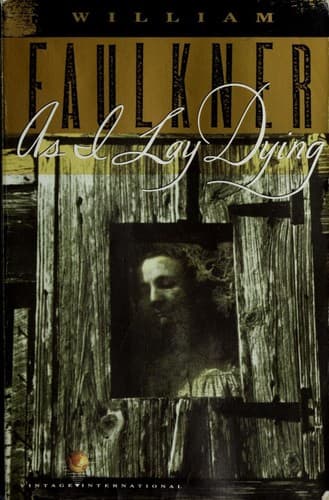
As I Lay Dying
William Faulkner·1930·Jonathan Cape and Harrison Smith·Literature
Reading level: Ages 16+ (adult) · 8-hour read · Advanced difficulty.
- Reading time
- 8h
- Difficulty
- Advanced
- Recommended age
- Ages 16+
- Guide read
- 6min
- Editor's rating
- 4.8 / 5
- faulkner
- american-literature
- southern-gothic
- classic
- experimental
- stream-of-consciousness
— In one sentence —
Fifteen narrators carry a dead woman across Mississippi. Each one sees something different. Faulkner shows you all of it.
§ 01 · WHY READ
Why read
Faulkner wrote As I Lay Dying in six weeks while working the night shift at a power plant, writing on an upturned wheelbarrow. He said he wrote it in one sustained effort, that he did not change a word of it, that it was perfect as written. He may have been telling the truth.
The novel has fifteen narrators — Addie Bundren's family and neighbors — who share the sections of a journey: the Bundren family is carrying Addie's coffin across Mississippi to Jefferson, where she asked to be buried with her own kin. The journey takes days and a flooded river and a barn fire and a broken leg and considerable rain. Each narrator sees differently, knows differently, understands differently. None of them has the full story.
The stream-of-consciousness here is not difficulty for its own sake. Each narrator's style is their consciousness: Darl, the most perceptive, speaks in the most syntactically complex prose because he perceives the most; Vardaman, the youngest child, speaks in fragments because that is how grief works in a seven-year-old; Cash, the carpenter, presents a numbered list of the fifteen reasons a coffin should be built on a bevel. The form is characterization. The sentences are the people.
The novel asks a question that has no satisfying answer: what is the self? Darl can perceive other people's interior states with uncanny accuracy but is uncertain of his own existence. Addie, who speaks once from inside her coffin — the only supernatural chapter, and the only one that explains the journey's true meaning — tells us that words are just things invented to fill gaps where real experience should be. The novel agrees with her.
§ 02 · CHARACTERS
Characters
Addie Bundren — dead before the novel begins, present throughout, and given one chapter from inside her coffin. Her account of her life and her marriage and what she thinks words are worth is the key to everything. She made Anse promise to bury her in Jefferson; the promise is all she had to give.
Darl — the second Bundren son, the most perceptive character in the novel, possibly the most perceptive character in Faulkner. He narrates nineteen of the fifty-nine chapters. His sections are the novel's most beautiful and most alarming: he knows things he should not be able to know, sees things that are not visible to him. His fate is the novel's moral crux.
Cash — the eldest son, the carpenter who built the coffin. His sections are short, practical, technical. He is the opposite of Darl: he does not analyze, he builds. His suffering — a broken leg set in concrete by his family, who know nothing about medicine — is the novel's most painful sequence.
Jewel — Addie's favorite son, illegitimate, born of her one act of deliberate life. He says almost nothing. He does everything. When the coffin needs to be saved from water and from fire, it is Jewel who saves it.
Vardaman — the youngest, seven years old, who cannot process his mother's death. His chapter — "My mother is a fish" — is three words. It is also the most precise rendering of grief's illogic in American fiction.
Anse — the patriarch, a man of comprehensive uselessness who has kept the journey's promise not out of love for Addie but because he wants to go to Jefferson for a set of store-bought teeth and a new wife. Faulkner makes him monstrous through accumulation.
§ 03 · HIGHLIGHTS
Three highlights
No. 1 · Addie's chapter. Addie Bundren speaks once, from inside her coffin, before the journey begins in the chronological sense — her chapter is placed in the novel's middle but set in the past. She tells us what words are worth: "just a shape to fill a lack." Anse, love, sin — words invented to contain experiences that overflow them. The chapter explains the journey and the novel's formal principle simultaneously. It is the most important chapter Faulkner ever wrote.
No. 2 · The river crossing. The Bundrens attempt to ford a swollen Mississippi River with a coffin on a wagon. The mules drown, Cash breaks his leg, the wagon tips, the coffin floats. The sequence is simultaneously farcical and harrowing. Faulkner gives it to multiple narrators in real time: the same event described from inside different consciousnesses as it happens. The technique has never been more precisely deployed.
No. 3 · Darl's burning of the barn. Darl sets fire to a barn with the coffin inside — an act of mercy, an attempt to end the journey before it becomes more grotesque. Jewel saves the coffin. Darl is sent to the state asylum. The act is sane; the world's response to it is not. The sequence is Faulkner's darkest joke.
§ 04 · EDITIONS
Recommended editions
| Edition | Why pick it |
|---|---|
| Vintage International (paperback) | The standard edition. The list of narrators at the front — who speaks in each section — is essential; use it as a bookmark. |
| Norton Critical Edition | Includes critical essays and biographical context; useful if you want the scholarly apparatus. Michael Millgate's introduction is excellent. |
| Audiobook (multiple voices) | This is one of the rare novels where multi-voice audio is the best format. The Brilliance Audio edition uses fifteen readers, one per narrator, which makes the formal architecture immediately audible. |
§ 05 · FIT
Who it's for / not for
Read this if you are…
- Readers who want to understand what stream-of-consciousness actually does — how it can be formal characterization rather than aesthetic pose.
- Anyone interested in how a novel can tell a single story from fifteen angles and leave you with something more true than a single perspective could provide.
- Faulkner first-timers: at 250 pages, this is shorter than Absalom, Absalom! and a more controlled demonstration of the same formal principles.
Skip it if you are…
- Bothered by structural difficulty. The fifteen narrators and non-linear chronology require active reconstruction throughout.
- Looking for an emotionally comfortable read. The novel is funny in places — Anse is a monster rendered comically — but the comedy does not soften the suffering.
§ 06 · TIPS
How to read it
Keep the narrator list at hand. You will lose track of whose section you are in without it. The sections are not labeled by name in the text body.
Read Addie's chapter twice: once when you reach it, once at the end. On the second reading, it will have explained everything you were confused by.
The shift in Darl's syntax as his sanity deteriorates is subtle. Track his sections carefully: there is a before and an after, and Faulkner marks it in the prose itself.
Accept Vardaman's "My mother is a fish" as a complete and adequate statement. It is.
§ 07 · COMPARE
Read alongside
- William Faulkner — The Sound and the Fury (1929). Written the year before; the predecessor in stream-of-consciousness and structural fragmentation. More emotionally devastating; As I Lay Dying is funnier and more formally controlled.
- Flannery O'Connor — The Violent Bear It Away (1960). A Southern Gothic road novel with a corpse and a religious argument. O'Connor at her most Faulknerian.
- Cormac McCarthy — The Road (2006). The contemporary equivalent of a journey-as-endurance novel, stripped of Faulkner's formal complexity but carrying the same interest in what people do when survival requires everything.
§ 08 · DISCUSSION
Discussion questions
- Each narrator has a different understanding of why the journey is happening and what it means. Whose understanding is most accurate? Is accuracy possible in this novel?
- Addie says that "love" and "sin" are just words invented to fill gaps where real experience should be. Does the novel agree with her? What evidence does it provide?
- Darl can perceive things he cannot see — Jewel's parentage, the scene at the birth. What is Faulkner suggesting about perception and consciousness?
- Vardaman's "My mother is a fish" is the novel's most famous line. What does it accomplish that a more conventional expression of grief would not?
- Darl burns the barn. The novel suggests this is an act of mercy and sanity. Why does the family send him to the asylum? Is the novel condemning them?
- Anse's final act — arriving in Jefferson with a new wife — is the novel's darkest joke. What is Faulkner saying about the nature of grief, obligation, and the drive to survive?
One line to remember
“My mother is a fish.”— Vardaman's chapter
You might also like
Read next
William Faulkner · 1936
Absalom, Absalom!
Four narrators reconstruct a man who destroyed his family. The story keeps changing. That is the point.
Read · 7 min
William Faulkner · 1932
Light in August
A man who does not know his race. A pregnant woman looking for her lover. A community that destroys what it cannot categorize.
Read · 6 min
William Faulkner · 1929
The Sound and the Fury
The fall of a Southern family told four times, from four perspectives, starting with a character who cannot tell time. Faulkner said he wrote it five times and never got it right.
Read · 5 min