Editor-reviewed
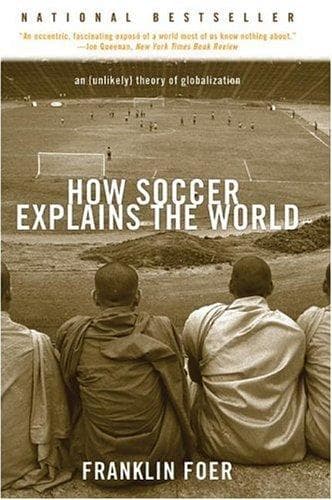
How Soccer Explains the World
Franklin Foer·2004·Harper Perennial·Sports
Reading level: Ages 15+ (adult) · 8-hour read · Beginner difficulty.
- Reading time
- 8h
- Difficulty
- Beginner
- Recommended age
- Ages 15+
- Guide read
- 4min
- Editor's rating
- 4.2 / 5
- soccer
- globalization
- football-politics
- sports-writing
- world-cup
— In one sentence —
A globalization tour through football: clubs, rivalry, politics, violence, capitalism, diaspora, and local loyalty.
§ 01 · WHY READ
Why read
How Soccer Explains the World is useful because it treats football as a social lens. Franklin Foer moves through clubs, rivalries, nationalism, capitalism, migration, violence, and global identity.
Some chapters now read like an early-2000s snapshot, but that is part of the point. The book captures football at a moment when globalization felt like both promise and threat. For World Cup readers, it helps explain why matches carry cultural arguments that statistics alone cannot hold.
§ 02 · CHARACTERS
Characters / people
The book is built around clubs, cities, supporters, political histories, and Foer's reporting presence. It is less about one star than about communities and symbols.
§ 03 · HIGHLIGHTS
Three highlights
No. 1 - It is short enough to start. This is a more accessible politics route than a full global football history.
No. 2 - It connects local and global. Clubs become examples of identity under pressure.
No. 3 - It gives context for fan intensity. Rivalry is rarely only about sport.
§ 04 · EDITIONS
Recommended editions
| Edition | Why pick it |
|---|---|
| Harper Perennial paperback | Easy to find and a good casual reading copy. |
| Ebook | Convenient if you want quick access during World Cup buildup. |
§ 05 · FIT
Who it's for / not for
Read this if you want football plus politics and culture. Skip it if you need a current data book, tactical history, or a neutral encyclopedia.
§ 06 · TIPS
Reading tips
Read it as reported essays. Ask what has aged, what still feels true, and what needs updating for today's game.
§ 07 · COMPARE
Read alongside
- David Goldblatt - The Ball Is Round. The bigger history.
- Simon Kuper and Stefan Szymanski - Soccernomics. Economics and data.
- Nick Hornby - Fever Pitch. Fandom from inside one life.
§ 08 · DISCUSSION
Discussion questions
- Which chapter best supports the claim that soccer explains more than soccer?
- Where does the book feel dated in a useful way?
- Can global football strengthen local identity rather than weaken it?
One line to remember
“A compact route into football as a way to talk about globalization and identity.”— bibliotecas editorial note
Appears in collections
Reading lists featuring this book
You might also like
Read next
Jonathan Wilson · 2008
Inverting the Pyramid
The classic modern tactics history for readers who want to understand what is happening on the pitch.
Read · 5 min
David Goldblatt · 2006
The Ball Is Round
A huge global history of football: empire, class, clubs, migration, money, nationalism, and the World Cup.
Read · 5 min
Eduardo Galeano · 1995
Soccer in Sun and Shadow
A short, literary football classic for readers who want the game as memory, politics, beauty, and ache.
Read · 4 min