Editor-reviewed
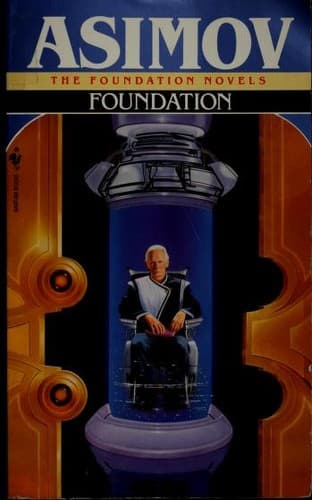
Foundation
Isaac Asimov·1951·Gnome Press / Random House Worlds·Sci-Fi & Fantasy
Reading level: Ages 14+ (adult) · 5-hour read · Intermediate difficulty.
- Reading time
- 5h
- Difficulty
- Intermediate
- Recommended age
- Ages 14+
- Guide read
- 7min
- Editor's rating
- 4.2 / 5
- science-fiction
- space-opera
- empire
- apple-tv-adaptation
- classic-sci-fi
— In one sentence —
The civilization-scale science-fiction classic to read before Apple TV's empire story swallows the book whole.
§ 01 · WHY READ
Why read
Foundation is the book to read if Apple TV's adaptation has made you curious about the original shape of Isaac Asimov's empire story. The series turns the material into a broader character drama, but the book is colder, stranger, and more idea-driven: Hari Seldon predicts the fall of a galactic empire and tries to shorten the dark age that follows.
That premise is still powerful because it changes the scale of the reader's question. Foundation is less about one hero saving the day than about institutions, probability, technology, and belief moving across centuries. The drama comes from watching people misunderstand the plan while still living inside its consequences.
Read it as a source book, not as a one-to-one map for the show. Apple TV expands characters and timelines. Asimov's novel gives you the conceptual engine: psychohistory, imperial decline, and the unsettling comfort of a future that may already be statistically trapped.
§ 02 · CHARACTERS
Characters
Hari Seldon matters less as an action protagonist than as the mind behind the plan. His confidence makes the book fascinating and morally uneasy.
The Foundation's early leaders show how a young institution survives without military strength. Their power comes from knowledge, myth, trade, and timing.
The collapsing Empire is almost a character in itself. It is huge, old, impressive, and increasingly unable to understand the forces moving underneath it.
§ 03 · HIGHLIGHTS
Three highlights
No. 1 - Psychohistory. The book's central idea still feels clean, provocative, and dangerous.
No. 2 - Short, linked crises. The structure moves through turning points rather than following one long quest.
No. 3 - Strong screen contrast. Reading the book helps you see what Apple TV changed: more characters, more emotion, more direct conflict.
§ 04 · EDITIONS
Recommended editions
| Edition | Why pick it |
|---|---|
| Random House Worlds paperback | A common English edition with stable Foundation-series packaging. |
| Mass market paperback | Compact and inexpensive if you want the classic series sequence. |
| Foundation trilogy set | Best if you plan to continue into Foundation and Empire quickly. |
| Ebook or audiobook | Good for the episodic structure and idea-forward pacing. |
§ 05 · FIT
Who it's for / not for
Read this if you are...
- Watching Apple TV's Foundation and want the original source logic.
- Interested in empire, prediction, and civilization-scale science fiction.
- Comfortable with a book driven more by arguments and crises than by intimacy.
- Looking for a short classic that opens a much larger series.
Skip it if you are...
- Expecting the same character arcs and emotional texture as the show.
- Wanting space battles on every page.
- Frustrated by older science fiction with sparse interiority.
- Looking for the strongest female-character work in the franchise.
§ 06 · TIPS
Reading tips
- Do not chase the show beat for beat. The adaptation is an expansion, not a simple filming.
- Track the crises. Each section tests whether Seldon's model still holds.
- Notice religion and trade. Asimov is interested in how knowledge becomes power.
- Keep going if the opening feels dry. The book gets sharper once the Foundation starts improvising.
§ 07 · COMPARE
Read alongside
- Frank Herbert - Dune. Another empire-scale classic, but far more ecological and religious.
- Liu Cixin - The Dark Forest. For civilization planning under existential threat.
- Arthur C. Clarke - Childhood's End. For grand, idea-forward science fiction.
- Ursula K. Le Guin - The Dispossessed. For political systems examined through fiction.
- Hugh Howey - Wool. A modern screen-adapted science-fiction society built on hidden structure.
§ 08 · DISCUSSION
Discussion questions
- Is psychohistory comforting, authoritarian, or both?
- Does the Foundation preserve civilization or replace one form of control with another?
- Why does Asimov make individuals feel small against historical forces?
- Which adaptation change makes the biggest difference to the story's meaning?
- Can a plan remain ethical if later generations cannot consent to it?
- How does the book treat religion as a technology of power?
- Is the Empire doomed because it is corrupt, or because it is too large to understand itself?
- What does the book gain and lose by moving so quickly through time?
One line to remember
“The most thrilling thing in Foundation is not a battle; it is the idea that history might have a shape.”— bibliotecas editorial summary, not a textual quotation
You might also like
Read next
Isaac Asimov · 1952
Foundation and Empire
The Foundation sequel where Asimov tests whether psychohistory can survive empire, conquest, and the Mule.
Read · 7 min
Ted Chiang · 2002
Stories of Your Life and Others
Ted Chiang writes 30-page stories that take longer to think about than most novels. He has won more awards per word than any writer alive.
Read · 5 min
Cixin Liu · 2008
The Dark Forest
Fan + author consensus pick for the best book in the trilogy. Two simple axioms derive the silence of the universe. After this one, you don't look at the night sky the same way.
Read · 5 min