Editor-reviewed
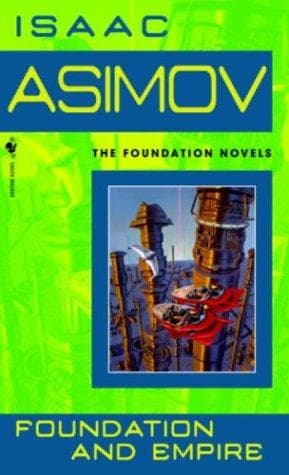
Foundation and Empire
Isaac Asimov·1952·Gnome Press / Bantam Spectra·Sci-Fi & Fantasy
Reading level: Ages 14+ (adult) · 6-hour read · Intermediate difficulty.
- Reading time
- 6h
- Difficulty
- Intermediate
- Recommended age
- Ages 14+
- Guide read
- 7min
- Editor's rating
- 4.2 / 5
- science-fiction
- foundation
- apple-tv-adaptation
- empire
- classic-sci-fi
— In one sentence —
The Foundation sequel where Asimov tests whether psychohistory can survive empire, conquest, and the Mule.
§ 01 · WHY READ
Why read
Foundation and Empire is the second Foundation book and the next source step for Apple TV viewers who want the original sequence behind Asimov's galactic history. Apple TV's adaptation expands the Foundation material into a larger ensemble, but the book keeps the central pressure clean: can Hari Seldon's plan survive both imperial force and the unexpected?
The first half looks back toward the Empire's military and political reach. The second half introduces the Mule, one of the classic disruptions in Asimov's future history. That shift matters because it tests the comfort of psychohistory. Prediction works best when people behave statistically; the Mule makes one person terrifyingly non-statistical.
Read it after Foundation if the idea of a planned future interested you but felt too tidy. This sequel is where the system starts to crack.
§ 02 · CHARACTERS
Characters
The Foundation's leaders and traders show how a young institution can become powerful enough to attract imperial attention.
The Empire's commanders give the old order one more serious attempt at control before decline becomes irreversible.
The Mule changes the series by making individual exception, emotion, and mutation a threat to historical math.
§ 03 · HIGHLIGHTS
Three highlights
No. 1 - The plan under stress. The book is strongest when Seldon's confidence begins to feel insufficient.
No. 2 - The Mule. Asimov gives the series a memorable answer to deterministic history.
No. 3 - Adaptation context. It helps show-first readers separate the show's expanded drama from the leaner book sequence.
§ 04 · EDITIONS
Recommended editions
| Edition | Why pick it |
|---|---|
| Bantam Spectra paperback | Common English edition with a stable ISBN trail. |
| Random House Worlds editions | Good for current Foundation-series packaging. |
| Foundation trilogy set | Best if you want Foundation, this book, and Second Foundation. |
| Ebook or audiobook | Good for the short, idea-forward structure. |
§ 05 · FIT
Who it's for / not for
Read this if you are...
- Continuing from Foundation after watching Apple TV's adaptation.
- Interested in empire, prediction, mutation, and historical disruption.
- Comfortable with older science fiction that moves by ideas and crises.
- Curious about the Mule before meeting later Foundation material.
Skip it if you are...
- Expecting the same character arcs as the Apple TV series.
- Wanting intimate psychological realism throughout.
- New to the series; read Foundation first.
- Looking for modern space-opera action on every page.
§ 06 · TIPS
Reading tips
- Read book one first. The sequel depends on knowing what the Seldon Plan promises.
- Watch the two-part structure. The book changes shape once the Mule becomes central.
- Ask what psychohistory cannot see. That is the sequel's real engine.
- Let the adaptation differ. Apple TV uses the source as a foundation, not a strict outline.
§ 07 · COMPARE
Read alongside
- Isaac Asimov - Foundation. The required first book.
- Frank Herbert - Dune Messiah. Another sequel that questions a prophetic system.
- Liu Cixin - The Dark Forest. For strategy and civilization under pressure.
- Hugh Howey - Shift. For a screen-adapted sequel that explains a system's origin.
- William Gibson - The Peripheral. For a later, stranger future controlled by unequal access.
§ 08 · DISCUSSION
Discussion questions
- What does the Mule reveal about the limits of psychohistory?
- Is the Foundation already becoming an empire of its own?
- Why does Asimov split the book between imperial pressure and the Mule?
- Does one exceptional person disprove the Seldon Plan or only expose its blind spots?
- How does the sequel make history feel less tidy than the first book?
- What should Apple TV preserve from the Mule storyline?
- Is prediction a form of wisdom or control?
- Does Foundation and Empire make the series more human or more unstable?
One line to remember
“Foundation and Empire is where Asimov asks whether history can be predicted after one impossible person enters the room.”— bibliotecas editorial summary, not a textual quotation
You might also like
Read next
Isaac Asimov · 1951
Foundation
The civilization-scale science-fiction classic to read before Apple TV's empire story swallows the book whole.
Read · 7 min
Ted Chiang · 2002
Stories of Your Life and Others
Ted Chiang writes 30-page stories that take longer to think about than most novels. He has won more awards per word than any writer alive.
Read · 5 min
Cixin Liu · 2008
The Dark Forest
Fan + author consensus pick for the best book in the trilogy. Two simple axioms derive the silence of the universe. After this one, you don't look at the night sky the same way.
Read · 5 min