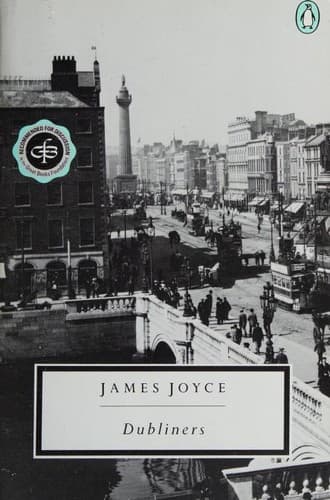
Editor-reviewed
Dubliners
James Joyce·1914·Grant Richards·Literature
Reading level: Ages 16+ (adult) · 8-hour read · Intermediate difficulty.
- Reading time
- 8h
- Difficulty
- Intermediate
- Recommended age
- Ages 16+
- Guide read
- 6min
- Editor's rating
- 4.8 / 5
- joyce
- irish-literature
- modernist
- short-stories
- classic
- canonical
— In one sentence —
Fifteen stories about a city that has stopped moving. The best story collection in English — and the most quietly devastating.
§ 01 · WHY READ
Why read
Dubliners was finished in 1905 and rejected or suppressed for nine years before it finally appeared in 1914. The publishers and censors who kept it from publication were responding to something real: the book is a sustained indictment of a city and a society, and the people in it would have recognized themselves.
Joyce organized the fifteen stories around his concept of "paralysis" — the condition he believed defined Dublin life. Not dramatic paralysis, not the paralysis of catastrophe or crisis, but the paralysis of people who cannot act, cannot leave, cannot change the things they know are wrong. The priest who has had his moment of crisis and returned to the Church. The young girl at the window who decides, at the last moment, not to board the ship. The man who realizes, mid-concert, that his wife is thinking about a boy who died for love of her twenty years before. The failure is always quiet; the damage is always real.
This is what Joyce invented with Dubliners and what every subsequent short story writer has had to grapple with: the technique of rendering the moment of revelation — the epiphany — not as triumph or resolution but as the recognition of what cannot be changed. The characters see clearly, once, and then the story ends. Whether they act on what they see is not the story's concern.
The final story, "The Dead," is one of the greatest works of short fiction in the language. It was written later than the others and functions as a kind of summation — more generous, more complex, more willing to let the paralysis become something like beauty.
§ 02 · KEY STORIES
Key stories
"The Sisters" — the collection's opening; a boy learns of the death of a priest who was his friend, and begins to understand, obliquely, that something was wrong with the man. Joyce's early technique at its most compressed: a story that knows more than it says.
"Eveline" — a young woman stands at the docks, ready to leave Dublin with a man who promises a different life. She cannot board the ship. The story's final image — her face "passive, like a helpless animal" — is among the most indelible in the collection.
"The Dead" — Gabriel Conroy and his wife Gretta attend a Christmas party. On the way back to their hotel, Gabriel realizes that his wife is not thinking about him but about a boy named Michael Furey who died for love of her when she was young. Gabriel's recognition — of what he has not been, of what another man was, of the snow falling over all of Ireland — is the collection's culmination and Joyce's most achieved piece of writing before Ulysses.
"A Painful Case" — Mr. Duffy rejects a woman who offers him love and intimacy; she later dies of an accident, probably suicide, and he reads about it in the newspaper. The story is about the specific damage done by the inability to accept connection.
§ 03 · HIGHLIGHTS
Three highlights
No. 1 · The ending of "Eveline." The prose up to this moment has been interior — Eveline's memories, her rationalizations, her fears. Then, at the dock: "She set her white face to him, passive, like a helpless animal. Her eyes gave him no sign of love or farewell or recognition." The shift to external perception is devastating. Joyce shows us what paralysis looks like from the outside, in the face of someone who has stopped.
No. 2 · The snow passage in "The Dead." Gabriel's recognition has been building across thirty pages of the story. The final passage — the snow falling over all of Ireland, over the living and the dead alike — achieves something rare in literary prose: the movement from personal pain to something impersonal and vast that is neither consolation nor despair but simply true. The repetition of "faintly" and "falling" is as close to music as prose gets.
No. 3 · "Araby"'s closing line. A boy goes to a bazaar to buy a gift for the girl he adores and arrives late, when the stalls are closing and the lights are going out. The story ends: "Gazing up into the darkness I saw myself as a creature driven and derided by vanity; and my eyes burned with anguish and anger." It is the moment of adolescent epiphany as Joyce defines it — the recognition of self-delusion, too late to change anything, but real.
§ 04 · EDITIONS
Recommended editions
The text is in the public domain; annotation varies significantly.
| Edition | Why pick it |
|---|---|
| Penguin Modern Classics | Clean text; introduction by Terence Brown with useful historical and biographical context; notes on Irish references. Recommended. |
| Oxford World's Classics | Scholarly apparatus; good notes on Dublin geography and Catholic culture; useful for close reading. |
| Viking Critical Library edition | Includes critical essays; more than casual readers need but valuable for study. |
The Penguin edition's contextual notes on Irish political and cultural life (Parnell, the Catholic Church, the nationalist movement) are worth reading before starting — many of the stories' tensions are legible only with this background.
§ 05 · FIT
Who it's for / not for
Read this if you are…
- Anyone approaching Joyce for the first time — this is the place to start, before Portrait and long before Ulysses.
- Readers who want to understand the short story as a form at its highest development: what stories can do with implication, silence, and the single revealed moment.
- Anyone interested in how literature renders the experience of living in a place that does not allow you to become what you might be.
Consider carefully if you are…
- Looking for dramatic plot or resolution. The stories' endings are typically not resolutions — they are moments of recognition, and what comes after is not the story's concern.
- Unfamiliar with Irish history and Catholic culture. The stories' weight depends partly on knowing what the institutions pressing on the characters actually meant. Brief background reading helps.
§ 06 · TIPS
How to read it
Read "Araby," "Eveline," and "The Dead" first to understand Joyce's range within the collection — from early adolescent epiphany to the most complex story he wrote. Then read the collection straight through; it is organized by age (childhood, adolescence, maturity, public life) and gains from being read in order.
Do not rush "The Dead." It is twice the length of the other stories and requires the same patience. The party sections build deliberately; the significance of what Gabriel does not see about his wife accumulates slowly.
§ 07 · COMPARE
Read alongside
- James Joyce — A Portrait of the Artist as a Young Man (1916). The next step; the stories' Dublin becomes the city Stephen escapes.
- Flannery O'Connor — A Good Man Is Hard to Find (1955). The American counterpart: a story collection organized around a single diagnostic vision of its place (the American South, spiritual emptiness). O'Connor read Joyce.
- Anton Chekhov — The Lady with the Dog and Other Stories. The most important predecessor for what Joyce does with implication and silence in Dubliners. Both writers knew that what a story does not say is as important as what it says.
§ 08 · DISCUSSION
Discussion questions
- Joyce called the collection's organizing theme "paralysis." Identify the moment in two or three stories where the paralysis becomes visible — when you can see the character stopping rather than choosing.
- "Eveline" ends without explanation. Why can't Eveline board the ship? Is it fear, duty, something else — or does the story refuse to answer?
- In "The Dead," Gabriel's recognition is both personal (his wife loved someone else) and impersonal (the snow falls on all the living and the dead). Why does Joyce need both? What does the impersonal vision add?
- The stories move from childhood to public life. Does Joyce's diagnosis — paralysis — apply differently across these stages of life?
- "A Painful Case" is about a man who cannot accept connection and pays for it. Is Mr. Duffy a victim of his character or his society?
- Dubliners was suppressed for nine years partly because publishers feared it would offend Dublin. Reading it now, what seems most dangerous about it?
One line to remember
“His soul swooned slowly as he heard the snow falling faintly through the universe and faintly falling, like the descent of their last end, upon all the living and the dead.”— James Joyce — The Dead
You might also like
Read next
James Joyce · 1922
Ulysses
One day in Dublin, June 16, 1904. The most technically ambitious novel in English — and funnier than its reputation suggests.
Read · 8 min
James Joyce · 1916
A Portrait of the Artist as a Young Man
The novel in which Stephen Dedalus becomes himself — and Joyce becomes Joyce. Essential before Ulysses.
Read · 7 min
William Faulkner · 1936
Absalom, Absalom!
Four narrators reconstruct a man who destroyed his family. The story keeps changing. That is the point.
Read · 7 min