Editor-reviewed
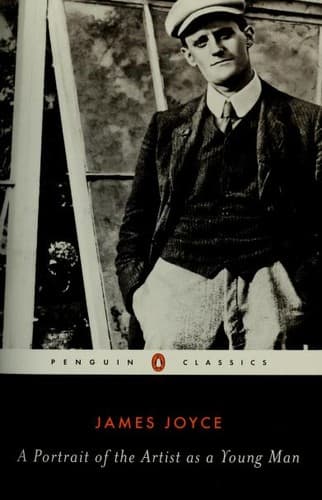
A Portrait of the Artist as a Young Man
James Joyce·1916·B.W. Huebsch·Literature
Reading level: Ages 16+ (adult) · 10-hour read · Intermediate difficulty.
- Reading time
- 10h
- Difficulty
- Intermediate
- Recommended age
- Ages 16+
- Guide read
- 7min
- Editor's rating
- 4.6 / 5
- joyce
- irish-literature
- modernist
- coming-of-age
- stream-of-consciousness
- classic
- canonical
— In one sentence —
The novel in which Stephen Dedalus becomes himself — and Joyce becomes Joyce. Essential before Ulysses.
§ 01 · WHY READ
Why read
A Portrait of the Artist as a Young Man is the novel in which Joyce perfected his major technical innovation before deploying it fully in Ulysses: the idea that prose style should reflect the consciousness of whoever is experiencing it at that moment. The novel opens with the toddler Stephen Dedalus — "Once upon a time and a very good time it was there was a moocow coming down along the road" — and the sentence is not pastiche of childhood language but an attempt to render how a very small child actually experiences narrative. As Stephen grows, the prose grows with him: the language of schoolboy religion, the lush and guilty rhetoric of adolescence, the hard-edged intellectual precision of the young artist.
This makes Portrait an unusually intimate account of how a mind forms. Stephen's progress from Clongowes Wood College through adolescence, through religious fervor and sexual guilt, through intellectual awakening at university, to the final decision to leave Ireland, the Church, and the constraints of home — all of it is rendered from inside the consciousness experiencing it, with no ironic distance the reader can shelter behind.
The novel is also a portrait of Ireland at the turn of the twentieth century: Catholic, nationalist, politically fractured, aesthetically provincial, and — in Stephen's view — stifling. His rejection of all three of his constraining institutions ("home, fatherland, church") is not triumph; it is achieved at cost. The closing diary entries, as Stephen prepares to leave, are excited and frightened in equal measure.
For readers going to Ulysses: this novel is not optional background. Stephen's presence in Ulysses — his guilt about his mother, his intellectual coldness, his relationship to Ireland — only makes full sense having followed him here.
§ 02 · CHARACTERS
Characters
Stephen Dedalus — both protagonist and subject of the portrait. The distance between who Stephen thinks he is and who the reader sees varies throughout; Joyce's technique of free indirect discourse lets us be inside Stephen's experience while maintaining just enough angle on it to see what he cannot. By the end of the novel he is brilliant, cold, and preparing to fly.
Simon Dedalus — Stephen's father, a man of wit and sociability and serial failure. His decline over the novel's course is tracked through Stephen's changing perception of him: hero, disappointment, embarrassment. The father-son relationship is one of the novel's most painful threads.
Cranly — Stephen's closest friend at university; the person Stephen confesses his intellectual and religious conclusions to before his departure. Cranly understands what Stephen is choosing and what it will cost; Stephen does not quite listen. The farewell between them is one of the novel's best scenes.
Emma — the girl Stephen admires at a distance through most of the novel; she is never clearly realized as a person, only as an object of Stephen's projected desire. This is deliberate — Joyce is showing us a young man who has not yet learned to see women as people. Ulysses acknowledges this failure.
§ 03 · HIGHLIGHTS
Three highlights
No. 1 · The hell sermon. In the third section of the novel, Stephen attends a retreat during which a Jesuit priest delivers a multi-chapter sermon on hell — its duration, its physical torments, the stench of sinners' bodies piled in infinite darkness. It is one of the most sustained and technically accomplished pieces of rhetorical prose in the novel, and Joyce renders it straight: we are inside Stephen's terror, not above it. The sequence ends with Stephen's confession and a temporary religious peace.
No. 2 · The epiphany on the strand. Stephen, walking on the strand, sees a girl standing in shallow water — wading, watching the tide. He has just refused to become a priest; the bird-girl on the strand becomes the figure of his artistic vocation: beauty, life, the world rather than the church. The prose at this moment rises to its most lyrical register — Joyce's equivalent of a conversion scene, but secular. The parallel with the religious ecstasy of the previous section is exact and deliberate.
No. 3 · The Christmas dinner argument. Early in the novel, the Dedalus family Christmas dinner becomes a catastrophic argument about Parnell — the fallen Irish nationalist leader — between Simon Dedalus, Dante Riordan (a fervent Catholic), and Mr. Casey. The argument is between politics and religion, between Irish nationalism and the Church that helped destroy it. Young Stephen watches. The scene establishes in miniature the forces that will shape him and that he will eventually have to choose between and reject.
§ 04 · EDITIONS
Recommended editions
The novel is in the public domain; edition quality varies.
| Edition | Why pick it |
|---|---|
| Penguin Modern Classics | Clean text, well-annotated edition by Seamus Deane; recommended. |
| Oxford World's Classics | Good scholarly apparatus; notes on the historical context, Dublin geography, and Irish political references. |
| Viking Critical Library edition | Includes critical essays useful for classroom or serious reading; more apparatus than most readers need but valuable for depth. |
Notes matter for this novel — the references to Irish history, Parnell, the structure of Jesuit education, and Dublin geography are specific and the text assumes familiarity with them.
§ 05 · FIT
Who it's for / not for
Read this if you are…
- Planning to read Ulysses — this is essentially required preparation, not optional background.
- Interested in coming-of-age narratives that take intellectual and religious experience seriously rather than treating them as mere backdrop to adolescent drama.
- Anyone interested in how prose style can be a technical argument — Joyce is demonstrating that the style of a sentence should reflect the consciousness producing it.
Consider carefully if you are…
- A reader who dislikes protagonists who are cold and self-important — Stephen Dedalus is both, and the novel does not fully excuse him for it.
- Someone looking for Irish fiction but not specifically Joyce — Colm Tóibín or William Trevor will give you Ireland with more conventional narrative warmth.
§ 06 · TIPS
How to read it
Read the five sections as five ages: infancy, boyhood, adolescence, early adulthood, departure. Each has its own prose register; if you notice the style shifting, you are reading correctly.
Pay attention to what Stephen refuses: the priesthood, his father's conviviality, Ireland's nationalist politics, his friend Cranly's plea to stay. The novel is structured around refusals. What he is moving toward — the artist's life, exile, silence — is defined by what he is turning away from.
Read the closing diary entries slowly. They are the only section written in first person, and the shift matters.
§ 07 · COMPARE
Read alongside
- James Joyce — Ulysses (1922). The necessary continuation. Stephen reappears, older and damaged, and his journey in Portrait is the context for everything he carries in Ulysses.
- James Joyce — Dubliners (1914). Read alongside or before Portrait to understand the Dublin Stephen is escaping. Many of the paralyses Dubliners diagnoses are what Stephen's flight is designed to avoid.
- D.H. Lawrence — Sons and Lovers (1913). Published three years before Portrait; another semi-autobiographical modernist bildungsroman about an artist-intellectual escaping provincial constraints, with a very different relationship to the mother than Joyce gives Stephen.
§ 08 · DISCUSSION
Discussion questions
- The novel's prose style shifts as Stephen ages — baby talk becomes schoolboy rhetoric becomes lyrical prose becomes hard intellectual precision. What does this technique argue about the relationship between language and consciousness?
- Stephen's three refusals — home, fatherland, church — are presented as liberation. What does he lose by making them, and does the novel acknowledge the cost?
- The hell sermon is rendered straight — we feel Stephen's terror as he feels it, without ironic distance. Why doesn't Joyce protect us with irony here?
- Emma is never clearly seen as a person; she exists as a screen for Stephen's projected desire. Is this Joyce's critique of Stephen, or is it simply the novel's limitation?
- Cranly understands what Stephen's departure means in a way Stephen doesn't fully acknowledge. What does their final conversation suggest about friendship and the cost of intellectual commitment?
- The bird-girl epiphany and the hell sermon are structural parallels — both are conversion experiences. What does Joyce gain by placing them so close together?
One line to remember
“I will not serve that in which I no longer believe, whether it call itself my home, my fatherland, or my church.”— James Joyce — A Portrait of the Artist as a Young Man
You might also like
Read next
James Joyce · 1922
Ulysses
One day in Dublin, June 16, 1904. The most technically ambitious novel in English — and funnier than its reputation suggests.
Read · 8 min
James Joyce · 1914
Dubliners
Fifteen stories about a city that has stopped moving. The best story collection in English — and the most quietly devastating.
Read · 6 min
William Faulkner · 1936
Absalom, Absalom!
Four narrators reconstruct a man who destroyed his family. The story keeps changing. That is the point.
Read · 7 min