Editor-reviewed
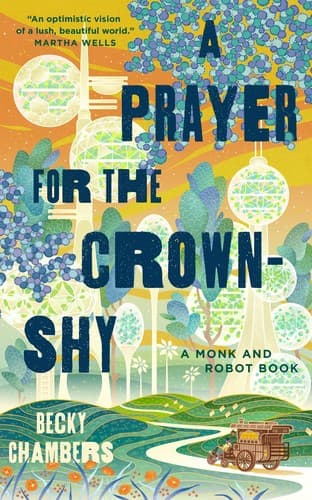
A Prayer for the Crown-Shy
Monk & Robot · Book Two
Becky Chambers·2022·Tordotcom·Sci-Fi & Fantasy
Reading level: Ages 14+ (adult) · 4-hour read · Beginner difficulty.
- Reading time
- 4h
- Difficulty
- Beginner
- Recommended age
- Ages 14+
- Guide read
- 5min
- Editor's rating
- 4.4 / 5
- solarpunk
- cozy-sf
- novella
- purpose
- community
- travel
- robots
— In one sentence —
Dex and Mosscap leave the tea route and walk into the harder question behind the first book: not what one person needs, but what people owe one another in a shared world.
§ 01 · WHY READ
Why read
A Prayer for the Crown-Shy is one of those sequels that proves the first book was asking a real question rather than just striking a mood. A Psalm for the Wild-Built introduced Dex, Mosscap, and the restorative calm of Panga; this second novella tests whether that calm can survive contact with other people, competing expectations, and the embarrassment of not having a neat answer for your life.
The setup is still small. Dex and Mosscap continue traveling, but the emotional scale shifts. The first book was mostly about inward drift: how a person can have a useful life and still feel wrong inside it. The second book is more social. Chambers asks what happens when personal uncertainty stops being private and starts affecting other people. The book's real subject is not purpose by itself but interdependence: how to stay open, useful, and kind without turning yourself into a machine for meeting demand.
That makes this a stronger book for some readers than Psalm. It is still gentle, still conversational, still committed to hopeful speculative fiction that does not confuse optimism with denial. But it has more friction. Dex gets irritable. Mosscap's curiosity becomes more complicated once humans stop being abstract. The world of Panga feels larger because it contains more than one intimate conversation. If the first novella comforted you, this one deepens the comfort by making it answerable to reality.
§ 02 · CHARACTERS
Characters
Sibling Dex - still a tea monk, still restless, but less protected by novelty. Dex now has to live with the fact that insight does not cure self-doubt for good. Chambers is very good at showing that a breakthrough can be real and still need maintenance.
Splendid Speckled Mosscap - no longer just the astonishing robot who asks a perfect question. Mosscap becomes funnier and sharper here because it has to navigate ordinary humans, mixed motives, and the limits of clean philosophical curiosity.
The people Dex and Mosscap meet - the supporting cast matters more in this volume. Chambers uses innkeepers, villagers, and passersby to show that even a humane society contains misunderstanding, projection, and ordinary emotional labor.
Panga itself - this is still one of the series' best characters. The repaired ecological future remains inviting, but Chambers keeps refusing utopian laziness. The point is not that everyone is enlightened. The point is that this society has built better conditions for asking better questions.
§ 03 · HIGHLIGHTS
Three highlights
No. 1 - The sequel expands the argument instead of repeating the vibe. Many cozy sequels simply give you more time with the same feeling. Chambers does more. She keeps the tenderness but moves from "What do I need?" toward "How do people live together without turning need into extraction?" That is a real conceptual step forward.
No. 2 - Dex gets to be difficult. This matters. If Dex stayed serenely improved after Book One, the series would collapse into therapeutic wallpaper. Instead Chambers lets Dex be touchy, embarrassed, defensive, and loving all at once. The result is warmer because it is less fake.
No. 3 - Hope is treated as a practice, not a mood. The novella's politics remain soft-spoken, but they are not empty. Chambers keeps returning to the idea that care requires repetition, limits, and mutual recognition. Hope here is not an aesthetic. It is something people do.
§ 04 · EDITIONS
Recommended editions
| Edition | Why pick it |
|---|---|
| Tordotcom hardcover (2022) | The first edition and the cleanest physical match if you already own the first Monk & Robot novella. |
| Tordotcom ebook | Ideal for reading in one evening; the book's rhythm survives digital reading very well. |
| Macmillan Audio audiobook | A good fit if you want the dialogue to feel even more companionable and lightly comic. |
Read this after A Psalm for the Wild-Built. The plot is simple enough that you could follow it alone, but the emotional payoff depends on carrying Dex and Mosscap's earlier question into this book.
§ 05 · FIT
Who it's for / not for
Read this if you are...
- Looking for hopeful fiction that is gentle without being vacant.
- Someone who liked Book One but wanted a little more social texture and resistance.
- In the mood for a short, thoughtful novel about burnout, boundaries, companionship, and usefulness.
- Building the
feel-good-fiction-that-still-makes-you-thinkshelf and want a book that is genuinely warm but not mindless.
Skip it if you are...
- Expecting a stronger plot engine than the first book. This is still a conversational novella, not a twist-driven sequel.
- Annoyed by earnest speculative fiction that says its values out loud.
- Looking for worldbuilding complexity or political systems detail as the main pleasure.
- Hoping the series will harden into conflict-heavy SF. Chambers stays deliberately intimate.
§ 06 · TIPS
Reading tips
- Read it close to Book One if you can. The series works best when Dex's earlier restlessness is still fresh in your mind.
- Notice where the book gets pricklier. The added friction is the sequel's main achievement, not a departure from the project.
- Do not confuse the calm prose with low stakes. The stakes are relational: misreading people, overextending yourself, and mistaking usefulness for worth.
- One sitting is ideal. The novella gains force from tonal continuity.
- If you want an even warmer landing, follow this with another compact humane novel rather than a grim counter-programming read.
§ 07 · COMPARE
Read alongside
- Becky Chambers - A Psalm for the Wild-Built (2021). Required first step; this sequel is best read as an answer that complicates an earlier question.
- TJ Klune - The House in the Cerulean Sea (2020). Another modern comfort read built on care, decency, and emotional rather than tactical stakes.
- Ursula K. Le Guin - The Dispossessed (1974). The more structurally demanding ancestor if you want communal ethics treated at larger political scale.
- Fredrik Backman - A Man Called Ove (2012). A different register of warmth: less speculative, more comic, but similarly interested in how difficult people rejoin community.
- Yoko Ogawa - The Housekeeper and the Professor (2003). A quieter literary pairing if what you want is gentleness with intellectual and emotional residue.
§ 08 · DISCUSSION
Discussion questions
- What has Dex actually learned from the first novella, and what have they merely recognized without being able to live out consistently?
- Mosscap's question about what people need becomes harder in contact with ordinary social life. Does the sequel answer it, widen it, or dismantle it?
- The series is often labeled cozy. Does that label still fit once the book starts dealing more directly with limits, resentment, and obligation?
- How does Chambers keep the repaired future of Panga from feeling smug or inert?
- Dex struggles with being needed by others. Where does the novella place the line between care and depletion?
- Would this book work for you without the ecological-utopian backdrop, or is that setting essential to its emotional effect?
- Which matters more in this novella: companionship, purpose, or permission to be unfinished?
- Does the book make hope feel persuasive to you, or only attractive?
One line to remember
“A Prayer for the Crown-Shy is a story of kindness and love.”— Publisher description
You might also like
Read next
Ted Chiang · 2002
Stories of Your Life and Others
Ted Chiang writes 30-page stories that take longer to think about than most novels. He has won more awards per word than any writer alive.
Read · 5 min
Cixin Liu · 2008
The Dark Forest
Fan + author consensus pick for the best book in the trilogy. Two simple axioms derive the silence of the universe. After this one, you don't look at the night sky the same way.
Read · 5 min
Octavia E. Butler · 1979
Kindred
Octavia Butler sends a Black woman from 1976 Los Angeles back to antebellum Maryland. The time travel is a device. The horror is real.
Read · 5 min