Editor-reviewed
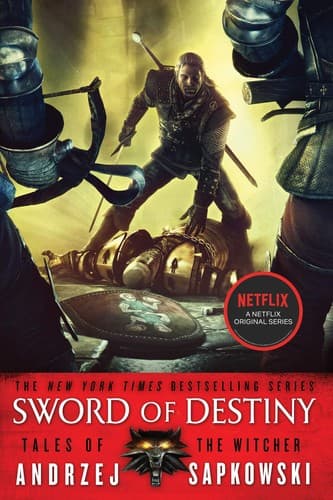
Sword of Destiny
Andrzej Sapkowski·1992·Orbit·Sci-Fi & Fantasy
Reading level: Ages 16+ (adult) · 8-hour read · Intermediate difficulty.
- Reading time
- 8h
- Difficulty
- Intermediate
- Recommended age
- Ages 16+
- Guide read
- 7min
- Editor's rating
- 4.3 / 5
- fantasy
- witcher
- short-stories
- netflix-adaptation
- polish-literature
— In one sentence —
The Witcher story collection where Geralt's contracts turn into Ciri, destiny, and the emotional spine of Netflix's saga.
§ 01 · WHY READ
Why read
Sword of Destiny is the second Witcher story collection in English reading order and the bridge between Geralt's monster contracts and the larger saga that Netflix adapts. Netflix identifies The Witcher as drawn from Andrzej Sapkowski's novels, and this book is especially important because it deepens the Geralt-Ciri destiny thread.
The Last Wish teaches the form: contracts, reversals, folklore, and moral traps. Sword of Destiny makes those stories feel less self-contained. Geralt's choices begin to matter beyond a single village or curse, and the idea of destiny becomes harder to dismiss as a story people tell after the fact.
Read it before the saga novels if you want the emotional foundation, not just the chronology. The collection explains why Ciri is not merely a plot device and why Geralt's neutrality keeps failing him.
§ 02 · CHARACTERS
Characters
Geralt of Rivia remains a professional, but this book exposes how thin his claimed neutrality can become.
Ciri changes the center of gravity. Her importance is not only magical or political; it is emotional.
Yennefer and Dandelion / Jaskier continue to complicate Geralt's self-image, pulling him toward attachment even when he speaks against it.
§ 03 · HIGHLIGHTS
Three highlights
No. 1 - Ciri's arrival. The book gives the Netflix saga's central relationship its source-book weight.
No. 2 - Folklore with consequences. The stories still work individually, but the aftereffects grow larger.
No. 3 - Clean reading order value. It is the strongest next step after The Last Wish before the full novels.
§ 04 · EDITIONS
Recommended editions
| Edition | Why pick it |
|---|---|
| Orbit paperback | Standard English translation and the easiest source-book edition. |
| Witcher boxed set | Best if you plan to continue through the saga novels. |
| Ebook | Good for reading one story at a time. |
| Audiobook | Useful for dialogue, folklore rhythms, and Geralt's dry voice. |
§ 05 · FIT
Who it's for / not for
Read this if you are...
- Continuing from The Last Wish and want the correct next Witcher book.
- Watching Netflix's The Witcher and want the source for Geralt and Ciri's bond.
- Interested in fantasy where destiny has emotional costs.
- Comfortable with darker fairy-tale material and political violence.
Skip it if you are...
- New to the books; start with The Last Wish.
- Wanting a single linear novel immediately.
- Expecting Netflix chronology to match the story order cleanly.
- Sensitive to violence, war trauma, sexual coercion themes, and cruelty.
§ 06 · TIPS
Reading tips
- Treat it as essential, not optional. The collection sets up the saga's heart.
- Watch the word destiny. Sapkowski uses it as comfort, trap, and argument.
- Keep Geralt's neutrality under suspicion. The book keeps proving that abstention is also a choice.
- Separate show memory from book sequence. The adaptation reshapes emphasis and timing.
§ 07 · COMPARE
Read alongside
- Andrzej Sapkowski - The Last Wish. The required first Witcher book.
- Robert Jordan - The Great Hunt. For another fantasy sequel about destiny becoming public.
- Leigh Bardugo - Shadow and Bone. For a YA screen-adapted fantasy contrast.
- Philip Pullman - The Golden Compass. For a younger mythic story with institutional danger.
- Frank Herbert - Dune. For prophecy, politics, and the cost of being named by others.
§ 08 · DISCUSSION
Discussion questions
- How does Sword of Destiny change Geralt's idea of neutrality?
- Why is Ciri important beyond plot mechanics?
- Does destiny in this book feel chosen, imposed, or invented afterward?
- Which story best connects folklore to political danger?
- How does Yennefer complicate Geralt's self-protective distance?
- What should Netflix prioritize when adapting these stories: sequence or emotional truth?
- Does Geralt become more heroic or less certain in this collection?
- Why does the short-story form work so well before the saga novels begin?
One line to remember
“Sword of Destiny is where Geralt's moral puzzles begin turning into family, prophecy, and loss.”— bibliotecas editorial summary, not a textual quotation
You might also like
Read next
Andrzej Sapkowski · 1993
The Last Wish
The best first Witcher book for Netflix viewers who want Geralt's world before the final seasons arrive.
Read · 7 min
Ted Chiang · 2002
Stories of Your Life and Others
Ted Chiang writes 30-page stories that take longer to think about than most novels. He has won more awards per word than any writer alive.
Read · 5 min
Cixin Liu · 2008
The Dark Forest
Fan + author consensus pick for the best book in the trilogy. Two simple axioms derive the silence of the universe. After this one, you don't look at the night sky the same way.
Read · 5 min