Editor-reviewed
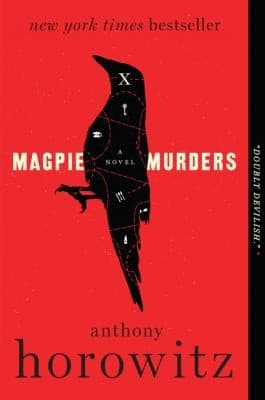
Magpie Murders
Anthony Horowitz·2016·Harper Perennial·thriller
Reading level: Ages 14+ (adult) · 11-hour read · moderate difficulty.
- Reading time
- 11h
- Difficulty
- moderate
- Recommended age
- Ages 14+
- Guide read
- 6min
- Editor's rating
- 4.1 / 5
- mystery
- pbs-masterpiece
- anthony-horowitz
- whodunit
- susan-ryeland
— In one sentence —
Anthony Horowitz's mystery-within-a-mystery, adapted for PBS Masterpiece and followed by Moonflower Murders.
§ 01 · WHY READ
Why read
Magpie Murders is Anthony Horowitz's nested mystery about editor Susan Ryeland and the final manuscript of fictional crime writer Alan Conway. PBS Masterpiece identifies its series as an adaptation of Horowitz's bestselling novel, and HarperCollins lists the Harper Perennial paperback with ISBN 9780062645234.
The book works because it understands the rules it is playing with. One layer is a classic village whodunit. The other is a publishing-world mystery about what the manuscript conceals and why its author is dead. Horowitz lets readers enjoy the old-fashioned puzzle while also asking what happens when a mystery novel becomes evidence.
Read it before the PBS series if you want the full double structure. Skip it if you dislike stories that pause one mystery to open another.
§ 02 · CHARACTERS
Characters
Susan Ryeland is the editor whose professional reading turns into a real investigation.
Alan Conway is the crime novelist whose manuscript may contain more than fiction.
Atticus Pund is Conway's fictional detective, built in the tradition of golden-age sleuths.
The Pye Hall suspects belong to the manuscript's village mystery, but their story echoes into Susan's world.
§ 03 · HIGHLIGHTS
Three highlights
No. 1 - PBS Masterpiece route. The official PBS page keeps the adaptation relationship visible for viewers.
No. 2 - Two puzzles for one read. The book gives you a classic mystery and a modern frame mystery.
No. 3 - Series unlock. It leads naturally to Moonflower Murders and the newer Susan Ryeland screen run.
§ 04 · EDITIONS
Recommended editions
| Edition | Why pick it |
|---|---|
| Harper Perennial paperback | Current US paperback with ISBN 9780062645234. |
| Orion UK edition | Useful if you want the original UK publication route. |
| Ebook | Good for moving between the manuscript and frame. |
| Audiobook | Strong choice because the two-story structure is clear in performance. |
§ 05 · FIT
Who it's for / not for
Read this if you are...
- Watching PBS Masterpiece's Magpie Murders or Moonflower Murders.
- A fan of Agatha Christie-style puzzles with a modern frame.
- Interested in publishing-world mysteries.
- Looking for a clever but readable adaptation source.
Skip it if you are...
- Avoiding murder, suicide references, or family secrets.
- Impatient with a book that changes narrative layers.
- Looking for gritty crime realism.
- Uninterested in affectionate genre commentary.
§ 06 · TIPS
Reading tips
- Do not skim the manuscript. The fictional whodunit carries evidence for the frame story.
- Track names and echoes. Horowitz likes parallels between the two layers.
- Read as a puzzle and as a joke about puzzles. The book enjoys the form without simply parodying it.
- Compare Susan on page and screen. The adaptation has to make editorial thinking visible.
§ 07 · COMPARE
Read alongside
- Agatha Christie - And Then There Were None. For a classic closed-circle mystery.
- Anthony Horowitz - Moonflower Murders. External follow-up and direct sequel.
- Richard Osman - The Thursday Murder Club. For a warmer modern mystery with adaptation demand.
- Wilkie Collins - The Moonstone. For an older mystery structure built from competing accounts.
- Tana French - In the Woods. For a darker crime novel where the detective's past matters.
§ 08 · DISCUSSION
Discussion questions
- Which mystery layer is more satisfying?
- How does the book use genre rules without feeling only nostalgic?
- What does Susan notice that a casual reader might miss?
- Does Alan Conway become more interesting through the manuscript or through the frame story?
- How should PBS handle the shift between Pund's world and Susan's?
- Where does the book play fair with clues?
- Does the publishing setting add stakes or mainly flavor?
- Why do fictional detectives keep working for modern readers?
One line to remember
“An editor reads a dead author's final manuscript and finds a second mystery hidden inside the first.”— bibliotecas editorial summary, not a textual quotation
You might also like
Read next
Agatha Christie · 1939
And Then There Were None
Ten strangers, one isolated island, and the cleanest demonstration in mystery fiction that a simple setup can still produce unbearable tension.
Read · 6 min
Daphne du Maurier · 1938
Rebecca
A second marriage, a country house, and a dead woman who seems more alive than everyone around her: du Maurier turns jealousy into one of the great slow-burn suspense novels.
Read · 6 min
John le Carre · 1974
Tinker Tailor Soldier Spy
John le Carre's George Smiley mole hunt, the source novel behind the BBC series and 2011 film.
Read · 6 min