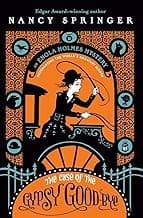
Editor-reviewed
The Case of the Disappearing Duchess
Nancy Springer·2010·Puffin Books·young-adult
Reading level: Ages 10–12 (middle grade) · 4-hour read · easy difficulty.
- Reading time
- 4h
- Difficulty
- easy
- Recommended age
- Ages 10–12
- Guide read
- 6min
- Editor's rating
- 3.8 / 5
- nancy-springer
- enola-holmes
- netflix-movie
- middle-grade-mystery
- sherlock-holmes
— In one sentence —
The sixth Enola Holmes mystery, published earlier as The Case of the Gypsy Good-bye.
§ 01 · WHY READ
Why read
The Case of the Disappearing Duchess is the sixth Enola Holmes mystery. Earlier editions used the title The Case of the Gypsy Good-bye; current reader-facing discussion is better served by the retitled edition while still acknowledging the bibliographic history.
Netflix/Tudum keeps the Enola Holmes films tied to Nancy Springer's mystery series, and Penguin Random House lists English editions across the sequence. This volume matters because it brings Enola's case work and family arc closer together.
Read it if you want the series' first major stopping point. The mystery begins with a missing duchess, but the emotional question is whether Enola can stay independent without cutting herself off from every family tie.
§ 02 · CHARACTERS
Characters
Enola Holmes is more capable than ever, but she is also tired of living only by evasion.
The missing duchess gives Enola a case that depends on class, reputation, and hidden movement.
Sherlock Holmes is closer to understanding Enola as a detective rather than only as a sister to recover.
Mycroft Holmes represents the social order Enola has spent the series resisting.
§ 03 · HIGHLIGHTS
Three highlights
No. 1 - Series payoff. It gives early Enola readers a sense of closure without ending the character's usefulness.
No. 2 - Family pressure. Sherlock and Mycroft matter because the case touches Enola's own future.
No. 3 - Adaptation path. Netflix's films make later-series reading more likely for families who start with the screen version.
§ 04 · EDITIONS
Recommended editions
| Edition | Why pick it |
|---|---|
| Puffin retitled edition | Current reader-facing route, commonly listed with ISBN 9780142418888. |
| Earlier Philomel/Puffin copies | Useful for collectors comparing the original title history. |
| Boxed set | Best if you want the first six-book arc together. |
| Library copy | Practical for younger readers finishing the early sequence. |
§ 05 · FIT
Who it's for / not for
Read this if you are...
- Near the end of the first Enola Holmes run.
- Interested in the Holmes family conflict.
- Looking for a middle-grade mystery with a stronger series arc.
- Coming from Netflix and continuing the books beyond the first case.
Skip it if you are...
- Starting Enola for the first time.
- Looking for a standalone Sherlock Holmes mystery.
- Avoiding older editions with dated title language.
- Wanting the bigger action rhythm of the films.
§ 06 · TIPS
Reading tips
- Read the earlier books first. The family payoff depends on the run-up.
- Use the current title. Older citations may use the original title, but the retitled edition is clearer for modern readers.
- Watch Sherlock's learning curve. His role changes as he sees more of Enola's work.
- Separate case closure from life closure. Enola's independence is still the real question.
§ 07 · COMPARE
Read alongside
- Nancy Springer - The Case of the Cryptic Crinoline. For the previous Enola case.
- Nancy Springer - Enola Holmes and the Black Barouche. For the later return to the series.
- Arthur Conan Doyle - The Adventures of Sherlock Holmes. For the canonical short-case rhythm.
- Karen M. McManus - One of Us Is Lying. For YA mystery with ensemble pressure.
- Agatha Christie - The Seven Dials Mystery. For a lighter missing-person puzzle.
§ 08 · DISCUSSION
Discussion questions
- Does this book feel like an ending, a pause, or a reset?
- How does the duchess case reflect Enola's own problem with family authority?
- What changes in Sherlock's view of Enola?
- How should readers handle the book's earlier title history?
- Which parts would a Netflix film likely expand?
- Does Enola need reconciliation, recognition, or distance?
- How does class shape the disappearance plot?
- Is Mycroft mainly comic, oppressive, or both?
One line to remember
“Enola takes on a duchess's disappearance while her own family story comes back into view.”— bibliotecas editorial summary, not a textual quotation
You might also like
Read next
Nancy Springer · 2006
The Case of the Missing Marquess
The first Enola Holmes mystery for readers following Netflix's film franchise.
Read · 6 min
Nancy Springer · 2022
Enola Holmes and the Elegant Escapade
An Enola Holmes sequel built around Lady Cecily, escape, and social control.
Read · 6 min
Nancy Springer · 2008
The Case of the Bizarre Bouquets
An Enola Holmes mystery about Dr. Watson's disappearance and a deadly bouquet.
Read · 6 min