Editor-reviewed
Oedipus Rex
Sophocles·-429·Various (public domain)·classic
Reading level: Ages 14+ (adult) · 2-hour read · Intermediate difficulty.
- Reading time
- 2h
- Difficulty
- Intermediate
- Recommended age
- Ages 14+
- Guide read
- 6min
- Editor's rating
- 4.9 / 5
- sophocles
- greek
- ancient
- tragedy
- drama
- oedipus
- fate
- canonical
- classic
— In one sentence —
The detective story where the detective is the criminal — and the crime was committed before the play begins.
§ 01 · WHY READ
Why read this
Aristotle called Oedipus Rex the perfect tragedy, and the play has been performing that perfection for twenty-five hundred years. Sophocles wrote a detective story: a man investigates a murder, pursues the evidence with relentless intelligence, and discovers that he himself committed it — and far worse — decades before the play begins. Every step Oedipus takes toward the truth is a step toward self-destruction, and he cannot stop, because stopping would mean accepting ignorance, and Oedipus cannot do that.
The structural achievement is immense. The audience in 429 BCE already knew the myth; they knew who had killed Laius and who Jocasta was. Sophocles' drama is not a mystery in the sense of withholding information from the audience — it is the spectacle of one man's intelligence dismantling his own life in real time, one question at a time. The dramatic irony is total and sustained for the play's full ninety minutes.
What makes the play more than a structural exercise is its refusal to moralize. Oedipus is not a bad man. He is, by every measure available to him, a good king and a diligent investigator. The crimes he committed were committed in ignorance. The fate that destroyed him was determined before his birth. Sophocles does not offer comfort on this point: the play ends with Oedipus blind, driven out of Thebes, and the Chorus observing that no one should be called happy until he is dead.
§ 02 · KEY CHARACTERS
Key characters
Oedipus — King of Thebes, brilliant solver of riddles, the man who answered the Sphinx. His intellectual pride — the same quality that makes him a great king — is what drives him to pursue the truth past every warning. He cannot stop asking questions. He is his own doom's engineer.
Jocasta — Oedipus' wife and, as it will emerge, his mother. She figures out the truth before Oedipus does and spends the play's second half trying to get him to stop investigating. Her lines urging him to let it go are among the most psychologically acute in ancient drama.
Tiresias — The blind prophet who knows everything and tells Oedipus the truth in the first act. Oedipus refuses to believe him. The play is a meditation on the relationship between sight and knowledge: the blind man sees; the king who sees is blind.
Creon — Jocasta's brother, the man Oedipus suspects of conspiracy. He is essentially innocent in this play (his complexity emerges in Antigone, where he is king and makes different choices). His dignity under Oedipus' accusations gives the play a moral anchor.
§ 03 · HIGHLIGHTS
Three highlights
No. 1 · The first encounter with Tiresias. Oedipus calls the blind prophet to help find the murderer of Laius. Tiresias tells him directly — you are the murderer; you are the pollution cursing Thebes. Oedipus responds with rage and accusations of conspiracy. The scene is the play's first full act of dramatic irony: the audience knows Tiresias is right; Oedipus' refusal to believe is completely understandable and completely wrong.
No. 2 · Jocasta's speech on oracles. To calm Oedipus, Jocasta tells him that Laius was killed by strangers at a crossroads — not by their son, who was exposed on a mountain as an infant. Then she says that an oracle told Laius his son would kill him, and the oracle was wrong. This speech is Sophocles' trap closing: everything Jocasta says to comfort Oedipus is, simultaneously, the evidence that convicts him.
No. 3 · The final messenger. An old shepherd, brought in to verify a small detail of Oedipus' birth, is the last witness. He tries to refuse to speak. Oedipus threatens him. The shepherd tells him everything. In this final scene Sophocles compresses twenty years of concealment into a five-minute interrogation, and the play's investigative structure — question, answer, horror — reaches its endpoint. Oedipus goes inside. We hear Jocasta scream.
§ 04 · EDITIONS
Recommended editions
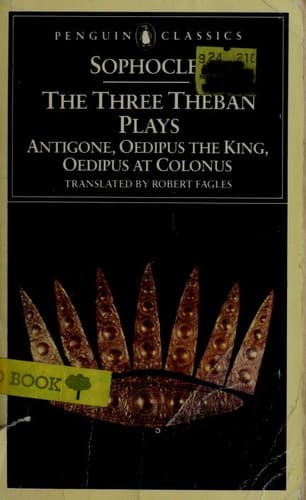
Robert Fagles translation (Penguin, 1982) — included in The Three Theban Plays with Antigone and Oedipus at Colonus. The translation is clear and stageable; Bernard Knox's introductory essay is required reading.
David Grene (University of Chicago Press) — the scholarly standard, part of the Complete Greek Tragedies series. Slightly more literal; excellent notes.
Stephen Berg and Diskin Clay — a more poetic, compressed translation good for reading the play as literature rather than as theater.
Read all three Theban plays together if possible (Oedipus Rex, Oedipus at Colonus, Antigone) — they were not written as a trilogy but complement each other directly.
§ 05 · FIT
Who it's for / Who it's not for
Oedipus Rex is for anyone interested in how narrative structure produces meaning. It is one of the most precisely engineered works in the Western tradition, and the engineering is visible without specialized knowledge — you can feel the trap closing without knowing anything about ancient Greek theater.
It is not for readers expecting catharsis in the redemptive sense. Oedipus is not purified by suffering; he is destroyed by knowledge. The play ends in exile and blindness, not resolution. If you come looking for a tragic arc that leads to wisdom earned, Oedipus at Colonus (the sequel) provides more of that. Oedipus Rex provides none.
§ 06 · TIPS
How to read it
The play is short — two hours of reading at most. Read it in a single sitting. The structure demands it; the dramatic irony only builds if you carry it continuously. Knowing the myth in advance is not a spoiler; it is how the play is designed to work. Sophocles' original audience knew exactly what was coming.
Pay attention to the sight and blindness imagery throughout. Tiresias is blind but sees the truth; Oedipus has full sight and sees nothing until he blinds himself. This is not accident — it is the play's central metaphor, running through every scene.
§ 07 · COMPARE
Read alongside
- Sophocles — Antigone. Written earlier but set later in the Oedipus myth; Creon becomes king and makes choices that reveal his character fully. The two plays in conversation show how Sophocles returned to the same family across decades.
- Sigmund Freud — The Interpretation of Dreams (1900). Freud named the Oedipus complex after this play. Whether you accept his reading or not, engaging with what he took from Sophocles changes how you see both.
- Seneca — Oedipus. The Roman version of the same myth, written for a reader rather than an audience, more rhetorical and more violent. A useful contrast to Sophocles' restraint.
§ 08 · DISCUSSION
Discussion questions
- Oedipus is innocent — the crimes were committed in ignorance. Does the play treat him as guilty? What does Sophocles mean by the plague Oedipus has caused?
- Jocasta figures out the truth before Oedipus does and tries to stop the investigation. What is she protecting — him, herself, or something else?
- Tiresias tells Oedipus the truth in the first act. Why does Oedipus refuse to believe him? Is this failure of reason or something else?
- The play is structured as a detective story where the audience knows the answer from the start. How does this affect your experience of watching Oedipus investigate?
- The Chorus ends the play by saying no man should be called happy until he is dead. Is this the play's argument, or is the Chorus wrong?
- If Oedipus had stopped investigating when Jocasta asked him to, what would his life have been? Does the play suggest he had a real choice?
One line to remember
“Count no man happy until he is dead.”— Sophocles — Oedipus Rex (tr. Fagles)
You might also like
Read next
Dante Alighieri · 1320
The Divine Comedy
The greatest poem ever written about getting lost — Dante descends through Hell, Purgatory, and Paradise to find out how to live.
Read · 8 min
Homer · -800
The Iliad
The foundational war poem — not a victory story but a furious argument about what war costs and what glory is worth.
Read · 7 min
Homer · -800
The Odyssey
The original homecoming story — ten years of sea and monsters, but what Odysseus is really traveling through is himself.
Read · 7 min