Editor-reviewed
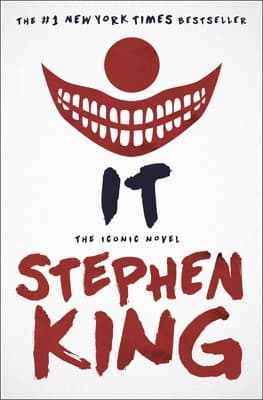
It
Stephen King·1986·Scribner·thriller
Reading level: Ages 16+ (adult) · 30-hour read · Advanced difficulty.
- Reading time
- 30h
- Difficulty
- Advanced
- Recommended age
- Ages 16+
- Guide read
- 6min
- Editor's rating
- 4.3 / 5
- stephen-king
- horror
- coming-of-age
- hbo-adaptation
- welcome-to-derry
— In one sentence —
Stephen King's huge Derry horror novel behind the films and HBO's Welcome to Derry.
§ 01 · WHY READ
Why read
It is Stephen King's large-scale horror novel about childhood, memory, and the way a town learns not to look too closely at its own violence. Warner Bros. Discovery's press page for IT: Welcome to Derry identifies the HBO series as based on King's novel, and Simon & Schuster lists the Scribner trade paperback with ISBN 9781501142970.
The book moves between two timelines. In 1958, seven children in Derry, Maine, face an entity that takes the form of what frightens them most. In 1985, the same people return as adults because the thing they fought has come back. The horror is famous, but the book works because King treats fear as social history: bullying, racism, family abuse, grief, and civic denial all feed the same place.
Read it if you want the source behind the films and the HBO Derry expansion. It is long, messy, and sometimes excessive, but it is also one of King's clearest arguments that childhood terror does not end just because adults stop naming it.
§ 02 · CHARACTERS
Characters
Bill Denbrough is the grieving older brother whose loss pulls the Losers together.
Beverly Marsh sees the monster and the human cruelty around it with equal sharpness.
Ben Hanscom brings loneliness, intelligence, and memory to the group's survival.
Richie Tozier, Eddie Kaspbrak, Stan Uris, and Mike Hanlon complete the Losers Club, each giving the novel a different version of fear and loyalty.
Derry is not just a setting. The town's habits of silence are part of the monster's protection.
§ 03 · HIGHLIGHTS
Three highlights
No. 1 - Child and adult timelines. The structure lets King compare what fear feels like before and after memory has been buried.
No. 2 - Derry as a system. The monster is terrifying because ordinary people help create the conditions where it can keep feeding.
No. 3 - Screen-source depth. The films and HBO series draw from a book with far more town history than any single adaptation can hold.
§ 04 · EDITIONS
Recommended editions
| Edition | Why pick it |
|---|---|
| Scribner trade paperback | Current official English edition with ISBN 9781501142970. |
| Media tie-in paperback | Useful for readers arriving from the films or HBO series. |
| Ebook | Practical for a very long novel. |
| Audiobook | A good option if the page count is the main barrier. |
§ 05 · FIT
Who it's for / not for
Read this if you are...
- Coming from It, It Chapter Two, or Welcome to Derry.
- Interested in horror that uses childhood and memory as its real subject.
- Willing to read a long novel with a large cast.
- Looking for a major Stephen King entry beyond the shorter classics.
Skip it if you are...
- Avoiding violence against children.
- Wanting lean plotting.
- Sensitive to dated language and disturbing sexual material.
- Looking for a simple monster story without social ugliness around it.
§ 06 · TIPS
Reading tips
- Give the structure time. The book builds force through repetition between childhood and adulthood.
- Track what Derry ignores. The town's denial matters as much as Pennywise.
- Do not expect the films to cover everything. Adaptations choose a spine; the novel sprawls by design.
- Read in sections if needed. This is one of King's longest books, and breaks make it easier to see the pattern.
§ 07 · COMPARE
Read alongside
- Stephen King - Salem's Lot. For small-town horror in a tighter form.
- Stephen King - The Outsider. For King turning crime evidence toward supernatural horror.
- Stephen King - The Stand. For another large King ensemble under pressure.
- William Golding - Lord of the Flies. For childhood group fear without the supernatural frame.
- Shirley Jackson - The Haunting of Hill House. External companion for psychological and architectural dread.
§ 08 · DISCUSSION
Discussion questions
- Why does King split the story between childhood and adulthood?
- Is Pennywise the cause of Derry's violence or the expression of it?
- Which fear in the book feels most human before it becomes supernatural?
- How does Mike's role as local historian shape the novel?
- What do the films gain and lose by simplifying the timeline?
- Does the book's length deepen the horror or dilute it?
- How should Welcome to Derry handle the town's history without repeating the novel?
- Is forgetting a defense mechanism, a failure, or both?
One line to remember
“Derry is the kind of town that remembers what its adults try to forget.”— bibliotecas editorial summary, not a textual quotation
You might also like
Read next
Stephen King · 1983
Pet Sematary
Stephen King's grief-horror novel behind multiple Paramount films.
Read · 6 min
Stephen King · 1974
Carrie
Stephen King's debut novel, newly timed to Prime Video's first Carrie television series.
Read · 6 min
Stephen King · 1975
'Salem's Lot
Stephen King's small-town vampire novel, newly useful again for readers coming from the Max film.
Read · 6 min