Editor-reviewed
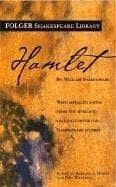
Hamlet
William Shakespeare·1600·Nicholas Ling / John Trundell (First Quarto, 1603)·drama
Reading level: Ages 14+ (YA) · 4-hour read · Intermediate difficulty.
- Reading time
- 4h
- Difficulty
- Intermediate
- Recommended age
- Ages 14+ (YA)
- Guide read
- 7min
- Editor's rating
- 4.9 / 5
- classic
- drama
- shakespeare
- tragedy
- revenge
- philosophy
— In one sentence —
The play that made interiority a subject for drama — and still hasn't been surpassed at it.
§ 01 · WHY READ
Why read
Hamlet is the longest play Shakespeare wrote, and the only one in which the main character seems to notice he's in a play. He quotes stage conventions, stages a play-within-the-play, mocks theatrical clichés, and at one point explicitly instructs the players on how to act. This is not irony about drama — it is the play's method. Hamlet is a man who watches himself think, and that self-watching is what makes him unable to act.
The plot is simple. Hamlet's father, the King of Denmark, has been murdered by Hamlet's uncle Claudius, who has married Hamlet's mother and taken the throne. The ghost of the murdered king tells Hamlet to take revenge. Hamlet, for four acts, does not. What happens in those four acts — the thinking, the circling, the self-accusation, the cruelty, the genuine grief — is the play.
What Hamlet does that nothing else quite does is make the inside of a mind the subject of drama. Before Hamlet, soliloquies told the audience what a character planned to do. Hamlet's soliloquies don't — they describe a mind that can't decide, that watches itself not deciding, and that finds its own indecision as interesting as any external event. The result is a character who feels more like a consciousness than a role. That is why every generation of readers finds a different Hamlet. There is room inside the text for him.
§ 02 · CHARACTERS
Characters
Hamlet is a philosopher who has been handed a revenge plot and finds the genre insufficient. He is genuinely witty, genuinely cruel, genuinely tender (especially toward Horatio), and genuinely paralyzed — not by cowardice but by an inability to believe that action can resolve the questions he keeps finding. He is also, periodically, terrible to the people who love him, and the play doesn't absolve him for this.
Claudius is the best villain in Shakespeare because he is not merely evil — he is effective. He has committed murder and usurped a throne, but he runs Denmark competently, he genuinely loves Gertrude, and his attempt to pray — the scene where he tries to repent and finds he can't because he is not willing to give up the benefits of his crime — is one of the most psychologically precise moments in the canon.
Gertrude is the play's most disputed character. Shakespeare gives her less interiority than Hamlet or Claudius, which means every actress and reader must decide how much she knows and how much she has chosen not to know. Both readings are available in the text.
Ophelia is assigned grief and madness by a plot that gives her no good options. Her actual madness — her songs, her flower distribution, her references — is doing real thematic work about what happens to feeling when it has no legitimate form of expression.
Horatio is the audience's position made human: someone who watches and witnesses and survives to tell the story.
§ 03 · HIGHLIGHTS
Three highlights
No. 1 · The Mousetrap (Act III, Scene 2). Hamlet stages a play reenacting his father's murder to confirm Claudius's guilt. The scene contains a play-within-a-play, Hamlet's running commentary to Ophelia and Horatio, Claudius's reaction, and the moment immediately after when Hamlet, having confirmed what he suspected, spirals into near-hysterical triumph rather than action. It is the play's pivot, and it shows exactly why confirmation of the truth doesn't solve Hamlet's problem.
No. 2 · Claudius at prayer (Act III, Scene 3). Hamlet finds Claudius alone and kneeling, apparently praying, and decides not to kill him — on the logic that killing him in prayer would send his soul to heaven, which is insufficient revenge for a man who murdered Hamlet's father during sleep. The audience knows Claudius's prayer has failed (he's just told us). Hamlet doesn't. He lets Claudius live for the wrong reason. The dramatic irony is precise and cruel.
No. 3 · "To be, or not to be" (Act III, Scene 1). The most famous speech in English literature is not about suicide — it is about the logic of endurance. Hamlet is working through whether consciousness is worth the suffering it guarantees, whether the unknown after death could be worse than the known suffering of life. The speech is great not because it answers the question but because it shows, in real time, a mind that keeps generating more complications every time it tries to reach a conclusion.
§ 04 · EDITIONS
Recommended editions
| Edition | Why pick it |
|---|---|
| Arden Shakespeare (Third Series, Ann Thompson & Neil Taylor) | The scholarly standard; accounts for the three distinct texts (Q1, Q2, F1); notes are exhaustive. |
| Oxford Shakespeare (G.R. Hibbard edition) | Based on the Folio text; excellent for performance-oriented reading. |
| Folger Shakespeare Library edition | Clean layout; notes on each page facing the text; best for first-time readers. |
| Penguin (T.J.B. Spencer edition) | Affordable; good introduction; the right choice if you want one uncluttered reading text. |
Film: Laurence Olivier's 1948 film and Kenneth Branagh's 1996 uncut version are both essential — Olivier for atmosphere, Branagh for completeness. David Tennant's 2009 RSC production (filmed for broadcast) is the best recent performance on record.
§ 05 · FIT
Who it's for / not for
Read this if you are… Anyone who has quoted the play without reading it. Anyone interested in how fiction handles the relationship between thinking and action — this is the foundational text. Readers who want a play that takes seriously the experience of not knowing what to do and not being able to do it anyway. Anyone who was assigned this in school and didn't finish it: try again, with a production in mind.
Skip it if you are… Looking for plot momentum. Hamlet moves slowly by design, and if you need narrative drive above all, Macbeth or Othello will serve you better. If you find the play's ambiguities (Gertrude's knowledge, Hamlet's sanity, the ghost's honesty) more frustrating than interesting, the text will test your patience in ways the other tragedies don't.
§ 06 · TIPS
How to read it
Watch a production before or alongside reading. The text was written to be performed, and the relationship between the soliloquies and the action is impossible to feel from the page alone. The Branagh film is useful specifically because it is uncut — you see every scene in sequence and can feel the play's actual length.
Read the three texts problem. Q1 (1603) is the "bad quarto" — shorter, probably reconstructed from memory; Q2 (1604) is the longest version, probably from Shakespeare's manuscript; the First Folio (1623) is slightly shorter and likely reflects performance cuts. Most editions print Q2 with Folio variants. The Arden Third Series prints Q1 separately, which is worth reading once for comparison.
Read the soliloquies aloud. They are written for a speaking voice, with rhythms that only work when spoken.
§ 07 · COMPARE
Read alongside
- Fyodor Dostoevsky — Crime and Punishment (1866). The nineteenth-century novel that most directly engages Hamlet's subject: a person who can think about a crime more completely than they can commit it, or escape it. The paralysis is inverted but the psychology rhymes.
- Tom Stoppard — Rosencrantz and Guildenstern Are Dead (1966). Hamlet from the perspective of two minor characters who don't understand the plot they're caught in. Reads as both comedy and philosophical companion piece; makes the existential stakes of Hamlet visible by treating them absurdly.
§ 08 · DISCUSSION
Discussion questions
- Hamlet has multiple opportunities to kill Claudius and does not take them. Which refusal is the most honest — the prayer scene, the aftermath of the Mousetrap, or somewhere else? What is he actually afraid of?
- The ghost commands revenge and Hamlet questions the ghost's honesty throughout. Is Hamlet's skepticism about the ghost's nature genuine intellectual scruple or a form of rationalized delay?
- How much does Gertrude know? Trace the evidence in the text for both interpretations. What does it change about the play if she knew?
- Hamlet is described by Ophelia as having been "the glass of fashion and the mould of form." We never see this Hamlet. What does it mean that the play begins after he has already been changed by grief?
- Claudius's failed prayer is the play's most sympathetic portrait of a guilty person. Does Shakespeare intend us to feel compassion for Claudius here? Does the play allow it?
- Horatio is asked to "report me and my cause aright / To the unsatisfied." The play we have just watched is presumably his report. How does this framing change the status of everything we've seen?
One line to remember
“To be, or not to be, that is the question.”— Act III, Scene 1
You might also like
Read next
William Shakespeare · 1606
King Lear
The play that asks what we owe each other when everything is stripped away — and gives no comfortable answer.
Read · 7 min
William Shakespeare · 1606
Macbeth
Shakespeare's shortest tragedy is also his fastest — a play about how quickly ambition destroys the person who acts on it.
Read · 6 min
William Shakespeare · 1603
Othello
A play about jealousy, race, and manipulation so precise it can still feel like an ambush.
Read · 6 min