Golden set · editor-reviewed
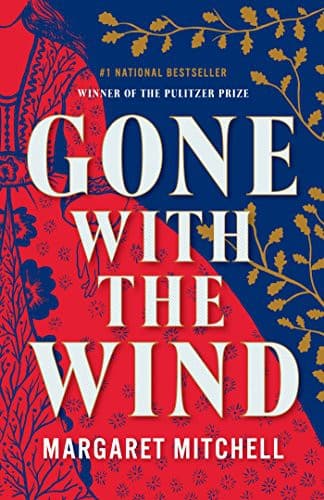
Gone with the Wind
A Novel of the American South
Margaret Mitchell·1936·Macmillan·Fiction
Reading level: Ages 14+ (adult) · 35-hour read · Intermediate difficulty.
- Reading time
- 35h
- Difficulty
- Intermediate
- Recommended age
- Ages 14+
- Guide read
- 5min
- Editor's rating
- 3.8 / 5
- american-literature
- civil-war
- lost-cause
- twentieth-century-bestseller
- contested-canon
— In one sentence —
The best-selling American novel of the twentieth century. Also a textbook of the Lost Cause myth. Read it with one eye on the page and the other on what the page is hiding.
§ 01 · WHY READ
Why read
If your position on principle is that you will not read a book that romanticizes the antebellum American South, this book is not for you. That is a fully defensible position, and skipping Gone with the Wind costs you nothing literarily — you can read Beloved, The Underground Railroad, or Sing, Unburied, Sing and have a more honest map of the same century. We do not need to argue you out of that.
If you are willing to read with one eye on the page and the other on what the page is hiding, Gone with the Wind does three things 1936 American literature almost no one else did.
One. Scarlett O'Hara is the most unsuitable mainstream heroine of her decade. She manipulates, lies, steals her sister's fiancé, marries for money, uses convict labor, and does not repent. Mitchell allows the book's most morally compromised woman to survive while every Lost Cause virtue around her dies. That is not the book's argument, but it is its accidental finding.
Two. The burning of Atlanta is among the best-written war passages in American fiction. Mitchell sets the dial to slow motion across thirty chapters and lets a city die. Whatever the book's politics, the prose-level craft of that section earns its place in the canon.
Three. It is a textbook of how the American South narrates itself to itself. This book is the cultural cornerstone of Lost Cause mythology — the post-war story in which the South was noble, the slaves were happy, and the war was about anything but slavery. Understanding twenty-first-century American political fracture — Confederate monument debates, the backlash to civil-rights memory, why Black Lives Matter produced the responses it produced — requires reading the opposing side's foundational text. This is that text.
A warning we owe the reader. The Black characters — Mammy, Prissy, Pork, Dilcey, Sam — are written within nineteenth-century racial conventions that today's standards correctly judge as harmful caricature. Mammy is dignified-but-dependent; Prissy is rendered for comic stupidity; the "loyal slave" frame governs every Black character's behavior. Read with the double consciousness the book never developed: enter Mitchell's world; never lose sight of what that world is hiding.
§ 02 · CHARACTERS
Characters
The novel is organized around a single binary: Scarlett vs. Melanie. Two women under one catastrophe; two opposite survival strategies; the book is, structurally, a long argument between them.
The binary
- Scarlett O'Hara — daughter of Irish-Catholic immigrants on the cotton frontier; "new South" embodied. Her tools are manipulation, denial, and a willingness to do whatever the next hour requires. She survives.
- Melanie Hamilton Wilkes — old-South gentility incarnate; physically frail; in possession of every moral judgment the book actually endorses. Mitchell said in interviews that Melanie, not Scarlett, is the heroine of the novel. Most readers don't believe her until the third read.
Scarlett's men
- Ashley Wilkes — Scarlett's idealized object; embodies the old order Scarlett claims to want but does not believe in.
- Rhett Butler — blockade runner, social outcast, more honest than anyone else in the book; Scarlett's mirror, and the only character whose perception of her is reliable.
- Charles Hamilton — first husband. A plot device.
- Frank Kennedy — second husband; her sister's fiancé; a moral cost the book asks you to weigh.
The families
- The O'Haras of Tara — Catholic Irish, plantation owners by determined acquisition.
- The Wilkes of Twelve Oaks — old aristocratic stock; the lineage Scarlett envies.
The servants · the book's most contested writing
- Mammy — written as dignified, opinionated, and absolutely loyal; one of the most-imitated racist tropes of twentieth-century American popular culture.
- Prissy — written for comic stupidity in ways that are difficult to read today and were noted as a problem by Black critics within years of publication.
- Pork · Dilcey — comparatively neutrally drawn, but still inside the faithful retainer frame.
Reading key: this novel has two layers. The surface story is Scarlett survives the war and Reconstruction. The buried story is how Southern whites tell themselves the story of their defeat. Both layers are doing work.
§ 03 · HIGHLIGHTS
Three highlights
No. 1 · The burning of Atlanta (Chapters 24–30). Mitchell stages the fall of Atlanta as long-form cinema decades before American film learned how to do it. The reader stands in the Atlanta streets in September 1864 and smells the timber burning. You can dislike the book's politics and admit, in good faith, that this stretch of prose is at the level of any twentieth-century English-language war writing.
No. 2 · "As God is my witness, I'll never be hungry again." End of Book One. Scarlett climbs out of the ruined fields of Tara and vows, to a sky no longer guaranteed to be listening, that she will never be hungry again. The line is famous because the film took it; the novel's version is harder. Scarlett is in this moment giving up the moral code of her class. Everything she does in the remaining seven hundred pages flows from this moment.
No. 3 · Rhett's exit. In a decade of American fiction in which protagonists got the love they wanted, Mitchell did something unusual: at the climactic moment, she lets her hero say no. Frankly, my dear, I don't give a damn. Scarlett, who has gotten everything else, does not get this. The novel ends in deferral — "After all, tomorrow is another day" — and Mitchell has the nerve to leave it deferred.
§ 04 · EDITIONS
Recommended editions
| Edition | Why pick it |
|---|---|
| Macmillan first edition (1936) | The canonical text. Long out of print as a first edition; later Macmillan paperbacks (1940s–60s) preserve it. |
| Pocket Books / Scribner reissue (2011, 75th anniversary) | Contains Pat Conroy's foreword, which is the best brief introduction to reading the book in the twenty-first century. |
| Penguin Modern Classics edition (UK) | Standard UK paperback. |
| 1939 film (Victor Fleming) | One of the most-watched films of the twentieth century. In 2020, HBO Max preceded the film with a four-minute introductory video on historical context. Watch the context video first, then watch the film. |
| The Wind Done Gone by Alice Randall (2001) | Required companion volume. A retelling from the perspective of an enslaved half-sister of Scarlett. This is the most useful single piece of writing for understanding what Mitchell could not see. |
| Audible · Linda Stephens narration (2011) | ~49 hours. The audiobook is excellent. |
Recommended order: HBO 2020 context video → Gone with the Wind (the novel) → The Wind Done Gone (Alice Randall) → 1939 film. Skipping the Randall is leaving 1/4 of the work on the table.
§ 05 · FIT
Who it's for / not for
Read this if you are…
- A reader of twentieth-century American literature and willing to engage with politically difficult material.
- A reader trying to understand contemporary American political fracture; this is the foundational mythology one half of that fracture grew up reading.
- A reader of survival narratives written about women, by women, in any decade.
Skip it if you are…
- Unwilling to read racism on the page. This is fully defensible. The book is racist in ways that hurt to read.
- Looking for a moral payoff in which the bad are punished and the good rewarded. The book does not deliver that.
- Younger than about twelve. The Civil War sequences are intense; the racism would require parental scaffolding most parents won't have time to do.
§ 06 · TIPS
Reading tips
- Difficulty: moderate. Language is accessible; cultural context is dense.
- Length: about 418,000 words; 30–40 hours. Among the longest popular novels of the twentieth century.
- Pace yourself. Two-volume reading helps. Pause after the burning of Atlanta + Tara's rebuilding; take a week; resume.
- Read Lost Cause materials in parallel. When you're 30% in, look up "Lost Cause myth" on Wikipedia or in any good introduction. The book becomes a different book once you can name the ideology it's transmitting.
- Do not let the film substitute for the book. The 1939 film cuts ~60% of the text, including the entire Klan sequence. The film is shorter, easier, and tells a more flattering story than the novel does.
§ 07 · COMPARE
Read alongside
- Toni Morrison — Beloved (1987). Same historical period, opposite vantage. Read in immediate sequence.
- William Faulkner — Absalom, Absalom! (1936). Mitchell and Faulkner were born in the same decade, wrote about the same defeat, won different prizes. Faulkner's literary ambition was larger; Mitchell's reach was wider. Both readings of the South.
- Colson Whitehead — The Underground Railroad (2016). Contemporary Black reimagining of the same century. Holds Gone with the Wind's blind spot up to light.
- Eileen Chang — Half a Lifelong Romance (1948). A wholly different culture's "twentieth-century women under historical catastrophe" novel. Useful out-of-American comparison.
§ 08 · DISCUSSION
Discussion questions
- Is Scarlett O'Hara a feminist icon or an anti-feminist warning?
- Mammy is often defended as a "dignified, complex" Black character. Is she — or is she the most influential version of the contented slave trope in American culture?
- Was Margaret Mitchell racist by the standards of her day, by the standards of ours, or both? Does authorial intent matter? The novel sold one million copies in 1936; whose desire was the novel meeting?
- Mitchell privately said the heroine of the novel was Melanie, not Scarlett. The text bears this out in places. Why have a hundred million readers believed otherwise?
- Rhett Butler walks away in the end. Is the exit a verdict on Scarlett, on the South, on both, or on neither?
- Should this book be taught in high schools? Under what preparatory framing? With what companion texts?
- Gone with the Wind is the textbook of the Lost Cause myth. How much of the contemporary American political backlash to civil-rights memory is downstream of this single book and its film?
- If you were asked to rewrite the ending — to give it the moral resolution Mitchell withheld — what would change, and what would you lose by changing it?
One line to remember
“After all, tomorrow is another day.”— Scarlett O'Hara — final line of the novel
Appears in collections
Reading lists featuring this book
7 books
The Best Books About Motherhood
Seven novels about motherhood handled with full weight — what it costs, what it makes possible, what it cannot prevent.
Open list →
10 books
Books About the American South
Ten books, ten Souths — some in direct contradiction.
Open list →
7 books
Read the Book Before the Movie
Seven books where the adaptation is good — but the book contains something the screen can't hold.
Open list →
10 books
Books That Earn Every Hour: Ten Essential Long Reads
Not long because they couldn't be shorter. Long because the size is the point.
Open list →
10 books
Ten Novels to Understand the American South
A literature that carries the full weight of American history — grace and violence together.
Open list →
6 books
Best Pulitzer Prize Novels Worth Reading Now
Six winners that held up — and one whose controversy is part of the point.
Open list →
You might also like
Read next
J. K. Rowling · 1999
Harry Potter and the Prisoner of Azkaban
The Harry Potter book built as a closed-loop mystery: no Voldemort duel, one escaped godfather, dementors as depression, and a time-turner ending that rewards rereading.
Read · 5 min
Kazuo Ishiguro · 2005
Never Let Me Go
A science-fiction novel so quiet about being science fiction that most readers finish it before they realize what they've agreed to.
Read · 5 min
J. K. Rowling · 2007
Harry Potter and the Deathly Hallows
Read for six books as a story about good defeating evil — actually a story about a seventeen-year-old learning to die. The subject was hidden in plain sight for six books before this one named it.
Read · 5 min